
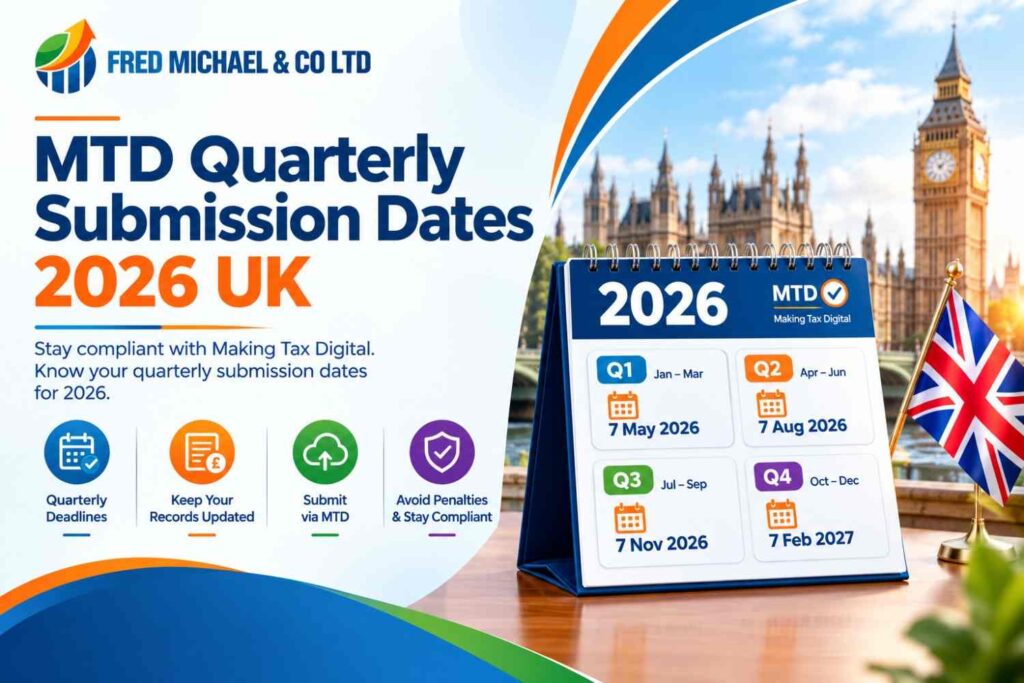
If you are self-employed or let out property, the next few weeks matter. The second quarterly submission under Making Tax Digital is due on 7 November, and HMRC expects it to be accurate, digital and on time. Missing the deadline can lead to penalty points and a lot of avoidable stress. For many owners, keeping up means tighter records, regular bookkeeping and a clearer view of the numbers throughout the year. That is why more people are turning to accounting services for small businesses to take the pressure off. A good accountant can organise your income and expenses, submit your updates correctly and spot problems early, so you stay compliant while focusing on running your business and growing with confidence.
What Are MTD Quarterly Updates and Why Does 7 November Matter?
Making Tax Digital replaces the once-a-year approach to reporting with regular digital updates. Instead of gathering everything after the tax year ends, you send HMRC a short summary of your income and expenses every quarter, using compatible software. These MTD for income tax quarterly updates give HMRC a running picture of your business, and they give you an earlier view of your own tax position.
The MTD quarterly update 7 November deadline matters because it is the second submission under the new rules, so HMRC will expect your process to be settled by now. A rushed submission is also more likely to contain errors. The good news is that a quarterly update is a summary, not a full tax return. With the right records and a clear routine, it is very manageable.
Who Needs to Submit MTD for Income Tax Quarterly Updates?
If you are wondering who needs to follow MTD for income tax, the test is your qualifying income: your gross self-employment and property income combined, before expenses. From 6 April 2026, anyone above the MTD for income tax £50,000 threshold, measured using their 2024-25 tax return, must follow the rules. The threshold drops to £30,000 from April 2027 and £20,000 from April 2028, so more people will be brought in over time.
MTD for sole traders and landlords works on the same basis, with income from both sources added together. Someone with £35,000 from consultancy and £18,000 of rental income, for example, has £53,000 of qualifying income and is in scope. Income from employment or dividends alone does not count towards the test. If you fall below the threshold, you can still sign up voluntarily, which some people do to spread the workload through the year.
MTD Quarterly Update Deadlines at a Glance
Most businesses use standard quarters that follow the tax year, though you can choose calendar quarters instead. The submission dates are the same either way.
Quarter | Standard period | Deadline |
1 | 6 April to 5 July | 7 August |
2 | 6 July to 5 October | 7 November |
3 | 6 October to 5 January | 7 February |
4 | 6 January to 5 April | 7 May |
After the fourth update, you submit a final declaration by 31 January following the end of the tax year. Note that 7 November 2026 falls on a Saturday, so do not leave it to the last day.
Because Making Tax Digital quarterly deadlines come round every three months, they also work as a planning rhythm. Many owners pair each one with cash flow management and forecasting in London, setting tax aside as they go so the January bill never arrives as a shock.
Your 7 November Deadline Checklist
Use this MTD for income tax checklist to get the quarter closed properly:
- Confirm you are signed up and that your software is authorised to send data to HMRC.
- Record every sale, invoice and receipt dated 6 July to 5 October.
- Reconcile your bank accounts against your records.
- Categorise expenses correctly and remove anything personal.
- Keep self-employment and property income separate.
- Compare the figures with last quarter and investigate anything unusual.
- Submit a few days early, ideally by Thursday 5 November.
- Save the HMRC confirmation for your records.
Steps two to five are where most of the time goes, and many businesses hand them to a provider of Bookkeeping and Accounting Services so the quarter is closed cleanly each time. Good bookkeeping also pays off later, because the same data feeds your self assessment tax return service in London at year end, with nothing rebuilt from scratch.
What Records Do You Need to Keep Digitally?
Under the rules, you must record income and expenses digitally, ideally as each transaction happens. For each entry, keep the date, the amount and a category. Photographs of receipts are fine as supporting evidence, but the figures themselves must live in your software or spreadsheet.
Good digital record keeping for MTD also means avoiding manual re-keying between systems. If data moves from one program to another, it should do so through a digital link, such as an import or an integration, rather than copy and paste. Keep your records for at least five years after the 31 January submission deadline for the relevant tax year.
If this sounds like a lot to maintain alongside running a business, accounting and bookkeeping services can set up the structure once and keep it tidy, so every quarter starts from reliable numbers rather than a shoebox of paperwork.
Read More : Employment Rights Act for Logistics and Construction Firms: Payroll Risks to Avoid
Choosing MTD-Compatible Software for Your Business
HMRC publishes a list of approved products, and the market for MTD compatible software UK is now broad. Options range from full cloud accounting packages to simple apps built for sole traders. Some also support spreadsheets through bridging software, which suits people who prefer to keep their existing workbook.
When comparing products, consider:
- Whether it handles both self-employment and property income
- Bank feeds and automatic categorisation
- Receipt capture on your phone
- Whether your accountant can work in the same system
- Price, and whether it scales if you grow
MTD for landlords has its own needs, such as splitting income by property and separating allowable costs from capital items, so check that the software handles this properly before committing. A free trial over a quarter is a good test.

How to Submit Your Quarterly Update to HMRC Step by Step
Here is how to submit MTD quarterly updates once your records are ready:
- Open your software and confirm it is linked to your HMRC account.
- Select the correct period, either standard or calendar quarter.
- Review the income and expense totals by category.
- Correct any errors or missing items before continuing.
- Submit the update and wait for HMRC’s confirmation.
- Save the receipt alongside your records.
If you prefer not to do this yourself, tax return accountants in London can submit on your behalf as your authorised agent, and the same team can review the numbers for sense before they go in. Many people find that using tax return services in London for the whole cycle, from quarterly updates through to the final declaration, is simpler than treating each filing separately.
You may remember the end of period statement MTD requirement from earlier plans. That separate step has been replaced by the final declaration, which brings your figures, adjustments and reliefs together in a single year-end submission.
Read More: Autumn Budget 2026: What UK Small Business Owners Need to Know Before 28 October
Common MTD Quarterly Update Mistakes to Avoid
Most problems come from habits rather than complexity. Watch for these:
- Mixing personal and business spending. This is a frequent issue with MTD for sole traders, and it distorts your profit figure.
- Leaving the work to the final day. Software outages and login problems are common near deadlines.
- Miscategorising expenses. Capital purchases and day-to-day costs are treated differently.
- Forgetting income paid outside your main account. Cash, card readers and online platforms all count.
- Ignoring tax set-asides. Updates show what you owe in real time, so budget for it.
A small business financial advisor in London can help you spot these patterns early and put simple controls in place. For growing firms with several income streams or staff, a Virtual Finance Director in London can go further, building reporting, forecasting and tax planning around the quarterly cycle.
Penalties for Missing the Deadline
HMRC uses a points-based system. Each late quarterly submission earns a penalty point, and when you reach the limit, which is four points for quarterly filers, a £200 penalty applies, with further £200 charges for each later miss. Understanding MTD penalties for late quarterly updates matters, because points can sit on your record for a long time. HMRC has also indicated a softer approach during the first year of the regime, but you should not rely on that. Late payment penalties and interest are separate and still apply.
If something genuinely prevents you from filing, such as serious illness or a software failure, you can explain a reasonable excuse to HMRC. Always check the current position on GOV.UK, since the rules and transitional arrangements can change.
Ready to get your 7 November update filed without the stress? Contact Fred Michael & Co Ltd today to book a consultation, and let our team take care of your digital records, quarterly submissions and tax planning.