
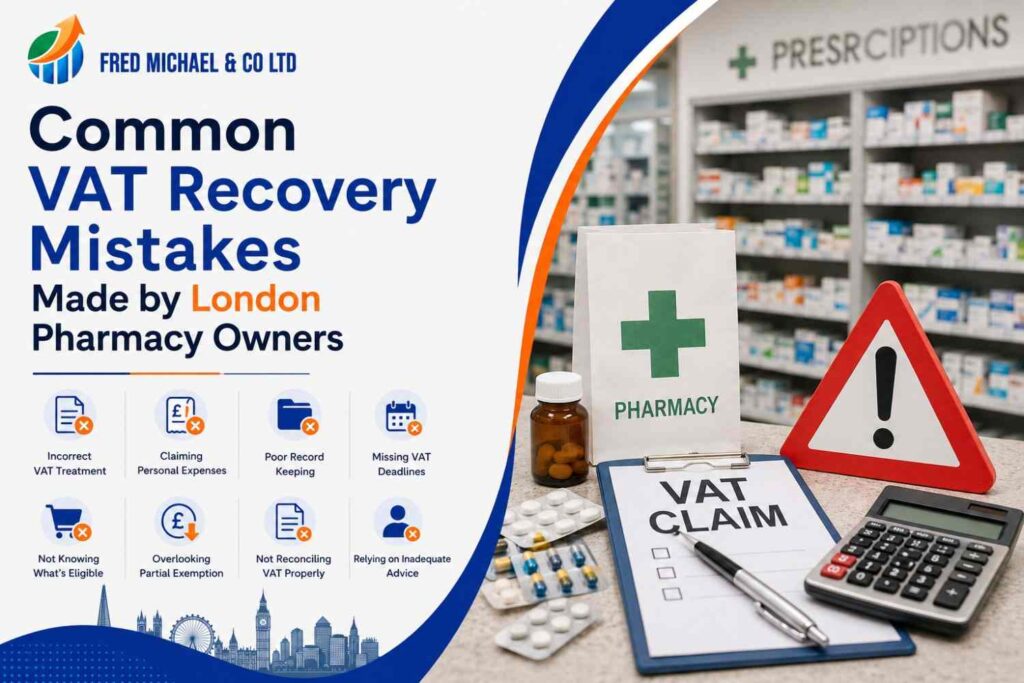
Running a pharmacy in London means juggling clinical responsibilities, staffing, stock control, and NHS contract compliance often leaving VAT as an afterthought. Yet few sectors have a more complicated VAT position than community pharmacy. Between zero-rated dispensing, exempt medical services, and standard-rated retail sales, pharmacies sit at the intersection of three VAT treatments within a single till transaction.
This complexity means mistakes are common, and they are rarely cheap. Many pharmacies either overpay VAT by failing to reclaim what they’re entitled to, or underpay and expose themselves to penalties during a VAT inspection. For London pharmacy owners who often operate on tighter margins due to higher rents and business rates getting VAT recovery right is a meaningful driver of profitability, and one of the clearest reasons owners bring in a specialist accounting service in London rather than relying on generalist bookkeeping. Below are the most common VAT recovery mistakes pharmacy owners make, and what to do instead.
1. Misunderstanding the Difference Between Zero-Rated and Exempt Supplies
This is the most frequent and costly error. Zero-rated and exempt supplies both appear as “0% VAT” on paper, but they are fundamentally different for recovery purposes.
- Zero-rated supplies (most NHS prescription dispensing) are technically taxable supplies charged at 0%, so the pharmacy can still reclaim VAT on related costs, rent, utilities, IT, professional fees, and so on.
- Exempt supplies (certain medical services, or medicines provided free of charge) fall outside the VAT system altogether. VAT on costs related to exempt activity generally cannot be reclaimed.
Owners who lump every “0%” transaction together treating dispensing income the same as exempt service income routinely under-claim recoverable VAT on overheads. Getting this classification right, line by line, is the foundation of accurate VAT recovery, and exactly the kind of detail a dedicated VAT accountant for pharmacies in London is trained to catch that a general accountant might miss.
2. Getting the Partial Exemption Calculation Wrong (or Skipping It Entirely)
Because most pharmacies make a mix of taxable and exempt supplies, they are “partly exempt” businesses for VAT purposes. This triggers a partial exemption calculation, apportioning VAT on general overheads between recoverable and non-recoverable amounts based on the ratio of taxable to total supplies.
Many pharmacy owners either:
- Never perform this calculation at all, defaulting to a blanket assumption that overhead VAT isn’t reclaimable, or
- Apply a rough estimate rather than following HMRC’s standard method (or an agreed special method), leading to under- or over-claims.
A “de minimis” rule also allows some pharmacies to reclaim all VAT on costs if exempt input tax falls below certain thresholds. Owners who don’t test against this each quarter can miss out on full recovery they’re entitled to.
Crucially, HMRC allows businesses to revisit partial exemption calculations up to four years back. Owners who assume a past error is “water under the bridge” are often leaving thousands unclaimed. This is where proper VAT recovery services in London pay for themselves, since a retrospective review can surface years of unclaimed overhead VAT in one exercise.
Read More: Specialist Pharmacy Accounting Services to Maximise Profits & Stay Compliant
3. Overlooking VAT on NHS Contractual Income Streams
NHS pharmacy income isn’t a single VAT category, it’s a patchwork. Essential services tied directly to dispensing are typically zero-rated, but various fees, allowances, and Advanced or locally commissioned services can be exempt, zero-rated, or standard-rated depending on who performs them and what they involve.
Dispensing-related payments are usually zero-rated, while services like the disposal of unwanted medicines or signposting are standard-rated, and clinically tailored advice from a registered pharmacist can be exempt as a medical service. Owners who apply a single VAT treatment across their entire NHS statement rather than breaking out each income stream frequently misclassify a meaningful portion of turnover, distorting both output VAT and the partial exemption ratio.
Because NHS Prescription Pricing Division statements often arrive two months in arrears, this mistake compounds: errors get baked into returns before the underlying figures are reconciled. Reconciling these statements properly is a core part of good pharmacy financial management, and an area where a sector-specific pair of eyes catches far more than a standard bookkeeping review.

4. Missing Recent Changes to PGD and Pharmacist-Led Service VAT Treatment
VAT treatment for pharmacy services has shifted meaningfully in recent years, and owners relying on outdated guidance are at real risk of misapplying the rules.
Two changes matter most:
- Since October 2023, medicines supplied under a Patient Group Direction (PGD) such as travel vaccinations, emergency contraception, or pain relief without a prior prescription have been zero-rated, extending the treatment previously reserved for prescription-only dispensing. This is currently set to run until March 2027.
- From May 2023, medical services directly supervised by a registered pharmacist can qualify for VAT exemption, where previously only services delivered by certain other registered health professionals were exempt.
Pharmacies offering travel clinics, vaccinations, minor ailment schemes, or private consultations should review whether these services are taxed correctly under the current rules, not the rules as they stood two or three years ago.
5. Poor Record-Keeping That Undermines Legitimate Claims
Even when the treatment is correctly understood, weak documentation can sink a claim:
- Not retaining valid VAT invoices, particularly for smaller or one-off expenses.
- Failing to separate retail till transactions from dispensing transactions in point-of-sale reporting.
- No clear audit trail showing how the partial exemption apportionment was calculated each period.
HMRC will only allow recovery of VAT supported by valid documentation. During an inspection, pharmacies with disorganised records often find previously claimed VAT disallowed, turning a straightforward recovery into an unexpected liability, complete with interest and penalties.
6. Choosing the Wrong VAT Scheme for the Business
Pharmacies can operate under different VAT accounting approaches, including standard VAT accounting with partial exemption, or in some cases flat rate arrangements. A flat rate scheme can simplify administration by applying a fixed percentage to turnover, but it isn’t always the most advantageous option once the true mix of zero-rated dispensing and exempt services is factored in.
Owners who adopt a scheme out of convenience or because a previous accountant set it up that way without reassessing whether it still suits their income mix, can end up paying more VAT than necessary as the business changes. A quick review with a chartered financial advisor in London every couple of years is usually enough to confirm the setup still fits.
7. Not Reviewing VAT Position When the Business Changes
VAT recovery isn’t a “set and forget” exercise. Common triggers for a fresh review include:
- Adding new services (travel clinics, weight management, private prescribing) that shift the taxable-to-exempt income ratio.
- Refurbishing or relocating premises, involving capital expenditure that may be reclaimable under the Capital Goods Scheme.
- New staff structures, such as clinical pharmacists taking over services previously done by other staff, changing their VAT liability.
Owners who don’t revisit their VAT position after these changes often keep applying an outdated apportionment method, drifting further from an accurate recovery position. Bringing in business financial advisors in London ahead of a big decision, rather than after it, tends to prevent this drift altogether.
8. Treating VAT as a Standalone Task Rather Than Part of Wider Financial Planning
One of the more subtle mistakes London pharmacy owners make is handling VAT in isolation, reviewing it only at return time, disconnected from cash flow forecasting or expansion plans. VAT recovery works best when it’s embedded into a pharmacy’s broader financial planning management in London, so decisions about new services, premises, or hires already account for their VAT impact, rather than discovering it later at reconciliation.
This is also why more owners are turning to a Virtual Finance Director in London instead of building a full in-house finance function. This role bridges day-to-day bookkeeping and strategic decision-making, covering VAT recovery alongside budgeting and profitability reviews at a fraction of the cost of a senior hire, a natural next step once a single pharmacy grows into a small group, when a second Virtual Finance Director in London engagement often pays for itself quickly.
Getting VAT Recovery Right
The recurring theme here is that pharmacy VAT is not static, it depends on an ongoing understanding of what each income stream is, who delivers each service, and how HMRC currently treats it. For London pharmacy owners managing high transaction volumes and multiple NHS contract elements, the margin for error is real, but so is the opportunity, particularly once VAT is folded into wider financial planning management in London rather than treated as an isolated compliance task.
A periodic VAT health check ideally annually, and after any significant change to services or premises is the most effective safeguard. A proper review of the partial exemption method and NHS income classification often covers unclaimed VAT going back up to four years, alongside a clearer position going forward. Given the complexity, working with pharmacy accountants in London who specialise in the sector, rather than general small-business tax, is typically the difference between guessing and getting it right.
Ultimately, pharmacies that recover the most VAT treat it as an ongoing conversation with trusted business financial advisors in London and a reliable small business financial advisor in London, not a once-a-quarter box-ticking exercise. The return is usually clear from the first review.
Why Hiring an Expert Healthcare Accountant Makes the Difference
General bookkeeping fails to grasp complex pharmacy tax law. Specialist London pharmacy accountants maximize overhead VAT recovery through precise partial exemption methods, reclaim four years of missed supplier input tax, and correctly categorize NHS income streams. In London’s high-cost environment, expert sector advice quickly pays for itself by recovering overlooked cash and eliminating costly HMRC compliance errors.
Final Thoughts
Navigating VAT recovery in a community pharmacy is far from a standard quarterly bookkeeping routine. With shifting regulations around PGDs, complex NHS income streams, and delicate partial exemption formulas, treating VAT as a box-ticking exercise almost always results in uncollected revenue or unwanted HMRC inspection exposure.
For London pharmacy owners operating under tight margins, getting this right provides an immediate cash injection and safeguards future profitability. A structured VAT review uncovers hidden efficiencies, reconciles past oversights up to four years back, and ensures your practice remains fully compliant.
If you suspect your pharmacy is leaving money on the table or want certainty around your VAT and partial exemption position, partner with a team that knows healthcare finance inside out. Contact Fred Michael & Co Ltd today to arrange a tailored pharmacy VAT and tax review, and discover how our specialist accounting service in London can protect your bottom line while keeping you fully compliant with HMRC standards.