
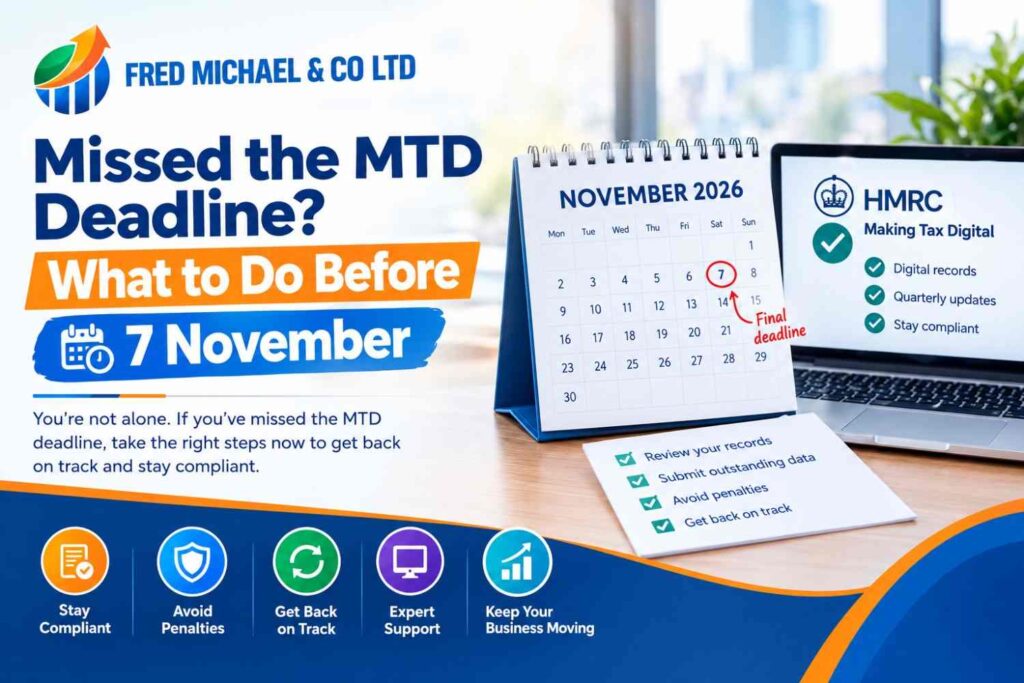
If you’re a sole trader or landlord facing a missed Making Tax Digital deadline UK taxpayers are talking about, you’re far from alone. Reports suggest nearly half of affected taxpayers missed the first quarterly deadline, although estimates vary. The good news is that the situation is recoverable, and you have about two weeks to put it right.
This guide explains the Making Tax Digital deadline 7 November 2026, what to do if you miss the MTD deadline, how to catch up, and how to avoid falling behind again. Specialist accounting services for small business owners, or reliable tax return services in London, can make the whole process far less stressful.
Whether you manage your own records or use accounting and bookkeeping services, the same rules apply under Making Tax Digital for Income Tax UK. Experienced tax return accountants in London see these cases every week, and most are fixable.
What Is the Making Tax Digital Deadline for 7 November 2026?
The HMRC MTD quarterly update deadline for the second period is 7 November 2026. Under the standard update periods it covers your income and expenses from 6 April to 5 October 2026 as a running total, and you must send it through MTD-compatible software. If you chose calendar quarters, the period is 1 April to 30 September, with the same deadline.
Three points are worth noting:
- It’s cumulative. The update isn’t just the last three months. It includes everything from the start of the tax year up to the end of the second period.
- It falls on a Saturday. The deadline is Saturday, 7 November 2026, and there’s no extension, so aim to submit by Friday 6 November. HMRC has confirmed extra helpline support around the weekend deadline.
- More deadlines follow. The next two are 7 February and 7 May next year.
These MTD requirements for sole traders UK-wide apply equally to Making Tax Digital for landlords UK, provided income is above the current threshold.
What Should You Do If You Miss the MTD Deadline?
Don’t panic, but don’t ignore it either. If you’re asking what to do if you miss the MTD deadline, the simple answer is to submit as soon as you can. If you missed the 7 August deadline, submit an update as soon as possible. A late MTD quarterly update UK taxpayers file now is far better than none, and HMRC rules for missed MTD deadlines are gentle in this first year.
A sensible order of action:
- Confirm you’re in scope. MTD for Income Tax applies to sole traders and landlords with income over £50,000, and HMRC uses earlier-year income to decide. Review your total self-employment and rental turnover from the 2024/25 tax year.
- Set up MTD compatible accounting software UK providers recognise. HMRC does not provide its own MTD software.
- Bring your digital records up to date for everything since 6 April.
- Submit your update, then diarise the next deadline.
ICAEW understands that HMRC intends to contact taxpayers who have signed up for MTD but are yet to submit their first-quarter update, so it’s better to act before you hear from them.

Will You Receive a Penalty for Missing an MTD Deadline?
For now, no. For the 2026/27 tax year, you won’t get a penalty point for a late quarterly update. HMRC has delayed introducing fines for MTD for Income Tax until April 2027. That’s the current picture on Making Tax Digital penalties 2026 UK businesses face. But the soft landing is narrow:
- Late payment penalties and interest still apply. No late submission penalty points will apply for quarterly updates, but late payment penalties and interest still apply.
- Self Assessment penalties continue. Late Self Assessment returns and late payments still carry penalties. A dependable self assessment tax return service in London can help you avoid them.
- The updates are still mandatory. A 2026/27 tax return cannot be filed unless all four quarterly updates have already been submitted. Making Tax Digital tax return deadlines UK sole traders face are therefore tied to your quarterly habits.
- Points start next year. From 2027/28, late quarterly updates earn one point per missed deadline. You receive a £200 fine once you reach the penalty threshold of four points.
Good HMRC tax compliance for self-employed UK taxpayers now means building the habit while mistakes are cheap.
How to Catch Up on Your Outstanding MTD Updates
The cumulative design makes catching up simpler than it sounds. If you also miss 7 November, your Q3 update, due 7 February, covers 6 April to 5 January and meets both obligations. Even so, leaving it that long gets harder, not easier.
If you need to know how to catch up on missed MTD updates, follow a practical plan:
- Gather everything: bank statements, invoices, receipts, mileage logs and rental statements from 6 April.
- Categorise carefully, and keep business and personal spending separate.
- Reconcile your bank accounts, because gaps and duplicates are the most common errors.
- Check for unrecorded items such as cash sales and one-off costs.
- Submit by Friday 6 November to leave a safety margin.
- Correct as you go. If you forgot an allowable expense in an earlier quarter, you can add it with the right date and category, and your next update will show the corrected total.
HMRC quarterly tax reporting for landlords follows the same pattern, with property income reported separately from self-employment. Taxpayers who miss quarter one must prepare that update while also compiling their quarter two report, so starting this week makes the job far more manageable.
Read More: Payroll Services for Your UK Business: A Comprehensive Guide
How Can Bookkeeping and Accounting Services Help With MTD?
MTD is built on records. The quarterly submission is the easy part, and getting clean, complete digital records is where most people struggle. The submission itself does not guarantee your records are accurate.
Professional Bookkeeping and Accounting Services can:
- Catch up your records so you can submit with confidence
- Set up compatible software and connect bank feeds
- Categorise transactions correctly, reducing errors
- Reconcile accounts monthly, not just at deadlines
- Submit quarterly updates on your behalf where authorised
- Prepare the final declaration, which replaces your Self Assessment return for 2026/27
If you’re short on time, outsourced accounting services can take the whole workload off your desk, and MTD accounting support for UK businesses can be tailored to your size and sector. Many owners also choose to outsource tax preparation services in London so quarterly updates, returns and records sit with one team. Local accountants in London know the practical pitfalls and can step in quickly. Quality Bookkeeping and Accounting Services also help you spot cash flow problems before they become tax problems.
How to Prepare for Your Next MTD Quarterly Update
Once you’ve caught up, make sure you don’t fall behind again. This short UK small business Making Tax Digital guide covers the habits that matter:
- Put every date in your diary now: 7 February and 7 May, with your own deadline a week earlier.
- Reconcile monthly, not quarterly.
- Scan receipts as you go, so nothing goes missing.
- Check your software’s tax estimate and set money aside regularly.
- Review cumulative totals, because each update builds on the previous one.
- Plan for the final declaration. It is the year-end submission that replaces your Self Assessment return.
- Watch the thresholds. HMRC says the threshold falls to above £30,000 from April 2027 and above £20,000 from April 2028, so more people will join.
Tax Planning services in London can also show how your quarterly figures feed into your final bill, so there are no surprises.
Read More: 7 Making Tax Digital Myths That Worry Small Business Owners
How Fred Michael & Co Can Help With Your MTD in Barking and London
At Fred Michael & Co, we help sole traders and landlords in Barking and across London get on top of Making Tax Digital. As trusted accountants in London, we offer tax return services in London alongside practical MTD support. Our team of tax return accountants in London can:
- check whether MTD applies to you
- set up and connect HMRC-recognised software
- bring your digital records up to date
- prepare and submit quarterly updates
- handle your self assessment tax return service in London needs, including the final declaration
- plan cash flow for your tax bill through Tax Planning services in London
Our accounting and bookkeeping services, outsourced accounting services and Bookkeeping and Accounting Services are designed for busy owners. We also provide accounting services for small business clients who want one team, and you can outsource tax preparation services in London to us with confidence. We explain every step in plain English, so you stay in control.
Final Thoughts
Missing the first MTD deadline is common and fixable. For 2026/27, you won’t receive a penalty point for a late quarterly update, and a later update can satisfy earlier obligations. But the updates remain mandatory, other penalties still apply, and the penalty-free period ends in April 2027. The sensible move is to catch up now, submit before Friday 6 November, and build a routine that keeps you ahead.
Behind on MTD? Contact Fred Michael & Co Ltd today. Our team will bring your records up to date, submit your update on time and keep you on track for the deadlines ahead. Get in touch now to book your MTD catch-up review before 7 November.