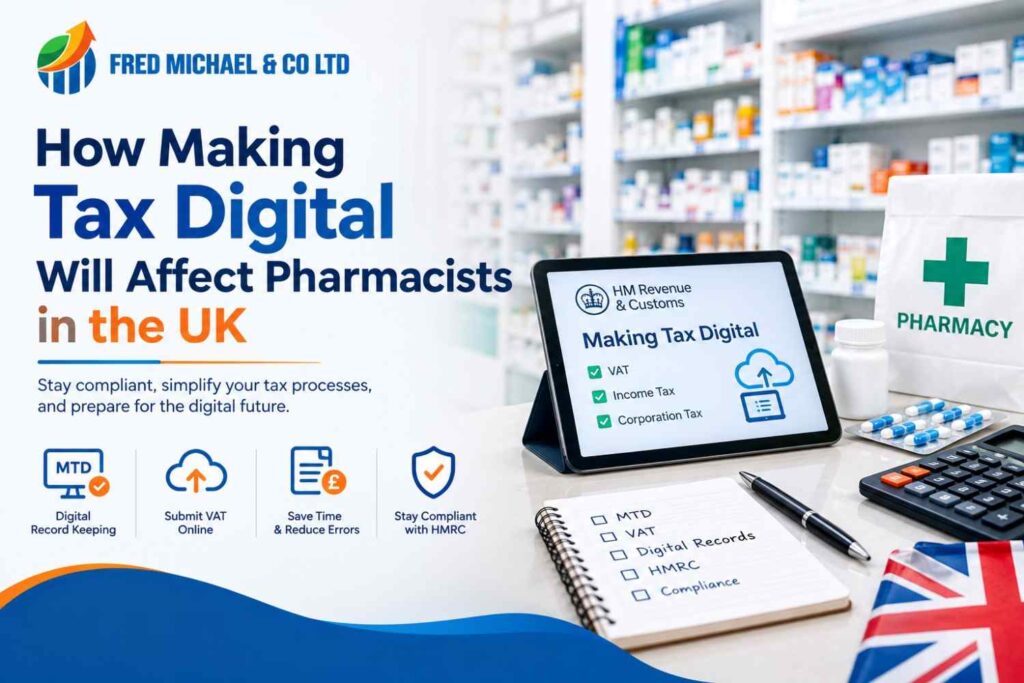
If you’re a self-employed pharmacist, locum, or independent pharmacy owner in the UK, you’ve probably heard the term “Making Tax Digital” (MTD) circulating in recent months. It’s one of the biggest shifts in how self-employed professionals report income in decades, and pharmacists are firmly within its scope.
Whether you run your own community pharmacy, work as a locum across multiple sites, or earn rental income alongside pharmacy work, understanding Making Tax Digital for pharmacists is essential to avoid penalties and stay compliant with HMRC’s digital-first approach.This article breaks down what Making Tax Digital means, when it applies to pharmacists, and what steps to take now including why many professionals turn to a specialist accounting service in London to manage the transition.
What Is Making Tax Digital?
Making Tax Digital is HMRC’s initiative to modernise the UK tax system by moving away from paper-based, manual annual tax returns toward continuous digital record-keeping and reporting. Instead of one Self Assessment return at year-end, taxpayers within scope must keep digital records of income and expenses and submit updates to HMRC every quarter using compatible software.
The goal, according to MTD HMRC United Kingdom guidance, is to reduce taxpayer errors and give individuals a clearer real-time view of their tax position, eventually phasing out the once-a-year Self Assessment process for many people.
MTD has already been mandatory for VAT-registered businesses since 2022. The next major phase Making Tax Digital for Income Tax (MTD for IT, formerly MTD ITSA) directly affects self-employed pharmacists and pharmacy business owners, and is being rolled out in stages from April 2026.
When Does MTD for Income Tax Start, and Who Does It Apply To?
MTD for Income Tax is being phased in based on gross income (before expenses) from self-employment and/or property:
- From 6 April 2026: mandatory for sole traders and landlords with gross income over £50,000
- From 6 April 2027: threshold lowers to £30,000, bringing more independent pharmacists and small pharmacy owners into scope
- From 6 April 2028: threshold reduces further to £20,000, capturing the vast majority of self-employed earners
For pharmacists, this matters because a large share of the profession works outside standard PAYE employment as locums, sole traders running independent pharmacies, or professionals with property income. If your combined gross income from self-employment and/or property exceeds the relevant threshold, the MTD requirements for self-employed pharmacists will apply to you regardless of your job title.
HMRC determines whether you’re mandated based on the gross income reported on your Self Assessment tax return for the relevant prior year. If you’re near a threshold, HMRC will typically write to confirm exactly the kind of correspondence a good self assessment tax return service in London can help you interpret and act on promptly.
Why This Matters Specifically for Pharmacists
Pharmacists occupy a unique position in the self-employment landscape, and several income patterns common to the profession make MTD particularly relevant. Broadly, Making Tax Digital UK pharmacists fall into a few categories:
Locum pharmacists. Many locums work across multiple pharmacies, NHS trusts, and agencies, invoicing separately for each engagement. Under MTD, this income must be tracked digitally and reported quarterly rather than compiled once a year, so consistent pharmacy bookkeeping becomes essential.
Independent pharmacy owners. If you operate your own pharmacy as a sole trader, your trading income will be directly subject to MTD once you cross the threshold. This includes dispensing income, private consultations, and retail sales all part of the pharmacy business accounting that now needs quarterly reporting.
Pharmacists with property income. It’s common in a stable career like pharmacy to hold buy-to-let property. MTD thresholds are based on combined gross income from self-employment and property, so a pharmacist with modest earnings but a rental property could be pulled into MTD sooner than expected, a key reason pharmacist income tax planning must look at your whole financial picture.
Pharmacists operating through a limited company. MTD for Income Tax currently applies to sole traders and landlords, not limited companies, which have separate Corporation Tax obligations. How you structure your business affects your obligations worth discussing with an accountant familiar with how pharmacist tax rules England applies differently to sole traders versus companies.
More broadly, UK community pharmacy tax changes like this reflect HMRC’s wider push toward a consistent digital framework, and pharmacy, with its high self-employment rates and mixed income, is squarely in scope.

What Will Change in Practice
Moving to MTD isn’t simply a matter of ticking a box, it changes how you manage your finances throughout the year:
- Digital record-keeping becomes mandatory. Spreadsheets, paper receipts, or manual notebooks will no longer meet HMRC’s requirements alone. You’ll need HMRC-recognised software to record income and expenses as they occur.
- Quarterly updates replace the single annual return. Instead of one Self Assessment submission after the tax year ends, you’ll submit a summary of income and expenses roughly every three months, a running summary feeding into your year-end position.
- An End of Period Statement (EOPS) and Final Declaration are still required. At year-end, you’ll finalise your figures and confirm your total tax position, building on the quarterly data already submitted.
- Software compatibility is essential. HMRC won’t accept manual submissions once you’re mandated, so you’ll need MTD-compatible software, whether that means adopting a new system or upgrading an existing one.
- Penalties for non-compliance. HMRC’s points-based penalty system means repeated missed deadlines accumulate points and eventually result in fines.
Read More : Pharmacy and Veterinary VAT: Understanding UK Tax Rules in 2026
Are There Any Exemptions?
Yes. Certain groups are automatically exempt, including those digitally excluded due to age, disability, location, or lack of reliable internet access, and those with genuine religious objections to digital record-keeping. Trusts, estates, and non-resident companies also fall outside MTD for Income Tax. If you think you may qualify, raise it with your accountant or HMRC before your mandatory date.
How Pharmacists Can Prepare Now
Even if your mandatory date isn’t until 2027 or 2028, preparing early saves stress later and puts you ahead on UK pharmacy tax compliance 2026 requirements. Consider the following steps:
- Check your qualifying income. Review gross income from self-employment and property over recent tax years to estimate when you’re likely to be brought into MTD.
- Choose MTD-compatible software early. Get comfortable with digital record-keeping tools in advance so the transition feels routine.
- Separate personal and business finances. Use a dedicated business account for pharmacy income and expenses to simplify record-keeping.
- Build a quarterly habit. Start reconciling income and expenses every three months now, even if not yet mandated, so it feels familiar once compulsory.
- Speak to a specialist. Locum work, dispensing income, NHS contracts, and private pharmacy revenue each have their own quirks. An MTD accountant for pharmacists UK who understands the sector can help set up systems built specifically for pharmacists, not generic sole traders.
Why Local Expertise Matters
While MTD is a nationwide rollout, many pharmacists particularly those running independent pharmacies or working as locums across the capital find real value in a team that understands both the profession and the local landscape. A firm offering tax return accountants in London combines national MTD expertise with genuine knowledge of how London-based pharmacies operate, from NHS contract nuances to local business costs.
If you’ve been searching for tax return services London pharmacists can rely on, or comparing accounting services for small business owners more broadly, choose a firm that specialises in healthcare professionals, the same goes if you need Making Tax Digital London pharmacists support specifically. Reliable tax return accountants in London and dependable tax return services London wide should feel like an extension of your own team, not just a once-a-year filing service.
For pharmacy owners, UK independent pharmacy owner tax planning also benefits from business financial advisors in London who can look beyond compliance to help structure your business efficiently and plan for growth. Whether you’re managing self-employed pharmacist tax obligations as a locum or running your own premises, the right business financial advisors in London can tailor advice to your specific circumstances. If you’re simply searching “pharmacy accountants near me UK”, prioritise a firm with demonstrable experience in pharmacy finances.
Final Thoughts
Making Tax Digital represents a genuine shift in how pharmacists whether locums, independent owners, or those with mixed income streams will manage their finances going forward. The days of gathering receipts once a year and hoping for the best are ending, replaced by consistent, digital, quarter-by-quarter reporting.
The good news is that with the right preparation, MTD doesn’t have to be a burden. Many pharmacists find that adopting digital record-keeping earlier gives them a clearer, real-time picture of how their pharmacy business or locum work is performing financially. Partnering with the right accounting and bookkeeping services provider turns stress into a straightforward, manageable routine.
If you’re a pharmacist unsure when MTD applies to you, which software to use, or how to structure your income tax-efficiently, don’t leave it until the deadline is close. Fred Michael & Co Ltd specialises in supporting pharmacists and healthcare professionals through this transition from choosing the right MTD-compatible software to managing quarterly submissions and year-end filings with confidence. As a trusted accounting service in London, we combine sector-specific knowledge with a genuinely personal approach, offering a self assessment tax return service in London built around the realities of pharmacy work, alongside full accounting and bookkeeping services and accounting services for small business support across the pharmacy sector. Get in touch with Fred Michael & Co Ltd today to book a consultation and make sure your pharmacy or locum practice is fully prepared for Making Tax Digital, well before it becomes mandatory for you.