
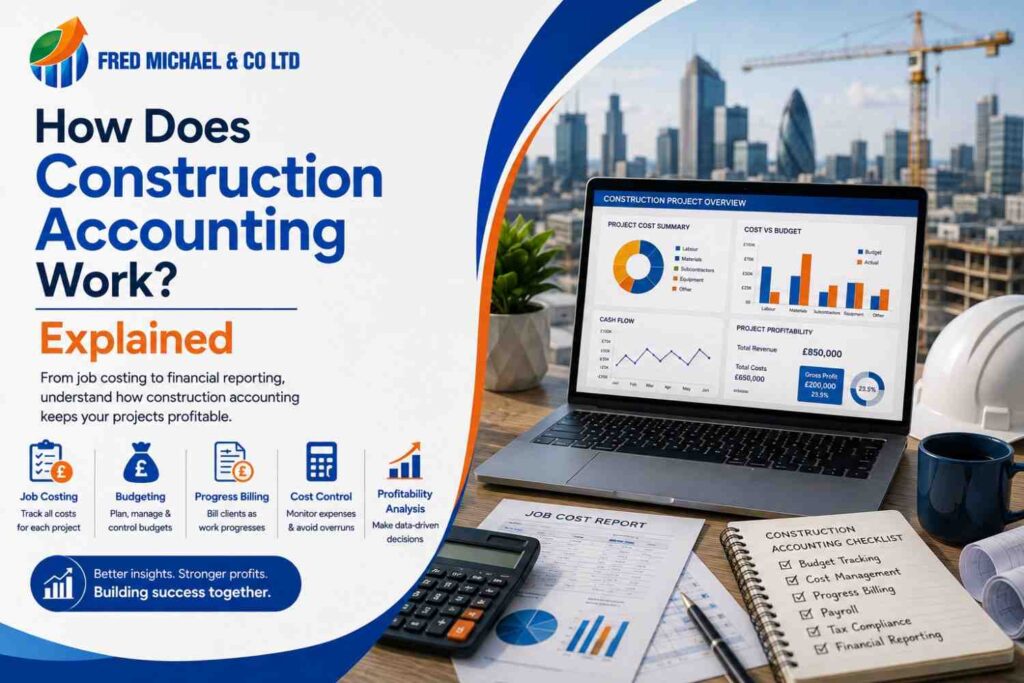
Construction is one of the most financially complex industries to run a business in. Unlike a retail shop or a consultancy that delivers a service and gets paid in a straightforward cycle, construction companies juggle multiple projects, staged payments, subcontractors, materials, equipment, and long timelines that can stretch across several accounting periods. A single job might run for months or even years, with money moving in and out at different stages depending on milestones, permits, weather delays, or client approvals, rather than on a predictable monthly cycle like most other businesses experience.
This complexity means that costs and revenue rarely follow a simple, linear pattern. Cash flow can shift dramatically from one month to the next, and profitability on any single project often isn’t clear until well after work has started, sometimes not until the job is finished entirely. Add in retainage, change orders, and a mix of direct staff and subcontractors, and it becomes clear why generic bookkeeping struggles to keep pace with the realities of the industry. This is exactly why construction accounting looks quite different from standard bookkeeping, and why so many contractors eventually turn to specialist bookkeeping and accounting Services to keep their finances organised, accurate, and genuinely useful for making decisions.
What Makes Construction Accounting Different?
Most businesses sell a single product or service with a predictable cost structure. Construction companies, on the other hand, run multiple projects at once, each with its own budget, timeline, subcontractors, and materials. A single job might span months or even years, with costs and revenue recognised gradually rather than all at once.
This is where dedicated bookkeeping and accounting services built specifically for contractors become essential. General-purpose bookkeeping isn’t designed to track costs by project, monitor retainage, or manage the cash flow swings that come with staged billing. Construction accounting has to account for all of this, which is why many firms rely on outsourced accounting support rather than trying to manage it entirely in-house.
Read More: Restaurant Accounting Services: Managing VAT, Payroll, and Cash Flow
Revenue Recognition: Percentage of Completion vs Completed Contract
One of the biggest differences between construction accounting and standard bookkeeping is how revenue is recognised. Because projects often span multiple accounting periods, contractors can’t simply record revenue when a client pays. Instead, they typically use one of two methods:
Percentage of Completion Method
This method recognises revenue and expenses in proportion to how much of the project has been completed. If a project is 40% complete, the contractor recognises 40% of the expected revenue. This gives a more accurate, real-time picture of financial performance across long-term contracts and is the method most commonly required for larger projects.
Completed Contract Method
Under this method, revenue and expenses aren’t recognised until the project is fully complete. This is simpler to administer but can create large swings in reported profit from one period to the next, since a big project might show no revenue for months and then a large lump sum once finished.
Choosing the right method and applying it consistently is a core part of how management accounting services in London firms help contractors present accurate, lender- and investor-ready financials. Consistent methodology across projects also makes year-end construction financial statements far easier to prepare and audit.
Work in Progress (WIP) Reporting
Closely tied to revenue recognition is Work in Progress (WIP) reporting. A WIP schedule tracks the costs incurred, billings issued, and revenue earned on each active project, comparing what’s been billed against what’s actually been earned.
This surfaces two common issues:
- Overbilling — when a contractor has billed more than the work completed, creating a liability
- Underbilling — when work completed exceeds what’s been billed, meaning cash hasn’t caught up with progress
Regular WIP reporting helps business owners spot these imbalances early, before they turn into serious cash flow problems. This is another area where management accounting services London providers add real value, turning raw project data into reports owners can actually act on.
Cash Flow Management in Construction
Cash flow is arguably the single biggest financial challenge in construction. Projects often require upfront spending on materials and labour long before the client payment arrives, and payment terms can stretch to 30, 60, or even 90 days. Cash flow management in construction is complicated further by retainage, staged billing, and the sheer number of moving parts across simultaneous projects.
This is why cash flow management and forecasting in London support is so valuable for contractors, it helps predict shortfalls before they happen and ensures there’s enough working capital to cover payroll, suppliers, and equipment costs between payment milestones. A solid forecast also gives business owners the confidence to take on new projects without overextending the business.
Retainage: Money Held Back Until the Job Is Done
Retainage is a construction-specific practice where a percentage of each payment (commonly 5-10%) is withheld by the client until the project is fully complete and approved. While retainage protects the client, it creates a real accounting challenge for contractors, who must track retainage held on each project separately from regular receivables, since it directly affects cash flow and available working capital.
Progress Billing and Change Orders
Construction projects are rarely billed as a single invoice. Instead, contractors use progress billing, invoicing clients at agreed milestones as work is completed. Each invoice needs to tie back to the job costing and WIP records to stay accurate.
On top of this, change orders modifications to the original scope of work happen constantly in construction. Every change order needs to be properly documented and reflected in the accounting records, adjusting both the budget and expected revenue for that project. Missing or poorly tracked change orders are one of the most common reasons construction projects lose profitability without anyone noticing until it’s too late.
Payroll in Construction: More Complex Than It Looks
Payroll is another area where construction accounting diverges from standard business bookkeeping. Many contractors employ a mix of direct staff and subcontractors, often across multiple job sites, sometimes under certified payroll requirements for public contracts. This is why many construction businesses use outsourced payroll services in London, rather than handling it manually.
Dedicated payroll support typically covers wage calculations across projects, subcontractor payment tracking, and ensuring compliance with tax and labour reporting requirements, all while allocating labour costs back to the correct job for accurate job costing. For growing contractors, bringing in outsourced payroll services in London early can prevent costly compliance mistakes down the line.
Credit Control: Keeping Payments on Track
Because construction relies so heavily on staged payments and retainage, effective credit control is essential. Chasing unpaid invoices, monitoring payment terms, and managing relationships with clients who are slow to pay can consume significant time and resources. This is where outsourced credit control support becomes valuable helping contractors maintain steady, disciplined credit management practices without diverting attention away from running projects.
Tax Planning for Construction Businesses
Construction companies face specific tax complexities, particularly around long-term contracts, equipment depreciation, and subcontractor payments. Proactive tax planning services in London help contractors structure their finances efficiently across tax years, rather than reacting at year-end. Many businesses also choose to outsource their tax preparation, since specialist support can identify allowable deductions and ensure compliance without pulling focus away from active projects.
Strong contractor tax compliance is non-negotiable in this industry, HMRC scrutinises construction businesses closely, particularly around subcontractor payments under schemes like CIS (Construction Industry Scheme). Regular tax return support also ensures returns are filed accurately and on time, factoring in the percentage of completion or completed contract figures already reflected in the accounts. Ongoing tax planning services in London support can also help contractors plan ahead for equipment purchases, capital allowances, and the tax impact of taking on larger, multi-year contracts.
When to Bring in a Virtual Finance Director
As construction businesses grow, managing more projects, larger contracts, and bigger teams may reach a point where they need senior financial oversight but aren’t ready for a full-time hire. This is where a virtual finance director can add real value, providing strategic input on cash flow, project profitability, and growth planning on a flexible, part-time basis.
Financial director-level support at this stage typically goes beyond bookkeeping, helping contractors interpret WIP reports, plan for seasonal cash flow dips, and prepare for larger tenders or investment. Alongside this, dedicated financial advisory support can help smaller contractors build the financial foundations needed to scale sustainably.
Why Specialist Construction Accounting Matters
Standard accounting practices simply weren’t built for the complexity of construction, multiple concurrent projects, staged billing, retainage, subcontractor payroll, and long revenue recognition timelines all require a different approach. Getting it wrong doesn’t just create messy books, it can hide unprofitable projects, create cash flow crises, and lead to compliance issues with tax authorities.
This is why so many contractors invest in dedicated accounting services for small business support tailored to construction, rather than relying on generic bookkeeping. Whether that means job costing systems, WIP reporting, payroll management, credit control, or tax planning, having the right financial structure in place is what separates construction businesses that scale successfully from those that struggle despite having plenty of work on the books. For smaller contractors just getting started, even basic accounting services for small business support properly set up from the outset can prevent many of the cash flow and compliance headaches that catch growing firms off guard later on.
Final Thoughts
Construction accounting is built around the realities of the industry: long project timelines, staged payments, subcontractors, retainage, and constantly shifting scopes of work. Understanding job costing, revenue recognition methods, WIP reporting, and cash flow management gives contractors the financial clarity needed to make confident decisions.
For many construction businesses, the smartest move is partnering with accountants who understand these industry-specific challenges, combining accurate bookkeeping with proactive cash flow, payroll, credit control, and tax planning support, so the business stays financially healthy no matter how many projects are running at once. Fred Michael & Co Ltd provides practical accounting support tailored to the needs of construction businesses. From keeping financial records organised to supporting tax planning and cash flow management, the right professional guidance can make managing your finances much easier.
Ready to strengthen your construction business finances? Contact Fred Michael & Co Ltd today to discuss how professional accounting support can help your business stay organised, compliant, and financially prepared for its next project.
Frequently Asked Questions
How does construction accounting work?
Construction accounting tracks costs and revenue by individual projects rather than for the business as a whole. It uses job costing, percentage of completion or completed contract methods, and WIP reporting to reflect long-term, multi-stage projects accurately.
How is construction payroll different from standard payroll?
Construction payroll often involves a mix of employees and subcontractors across multiple sites, sometimes under certified payroll rules.
What is the percentage of the completion method?
This method recognises revenue and expenses based on how much of a project is finished. If a job is 40% complete, 40% of expected revenue is recorded, giving an accurate, ongoing view of financial performance.
What is retainage in construction accounting?
Retainage is a percentage of each payment, typically 5–10%, withheld by the client until a project is fully complete and approved. It must be tracked separately from regular receivables, as it directly impacts cash flow.
What is WIP (work in progress) reporting?
A WIP schedule compares costs incurred and revenue earned against amounts billed on active projects. It highlights overbilling or underbilling early, helping contractors avoid cash flow surprises before they become serious problems