
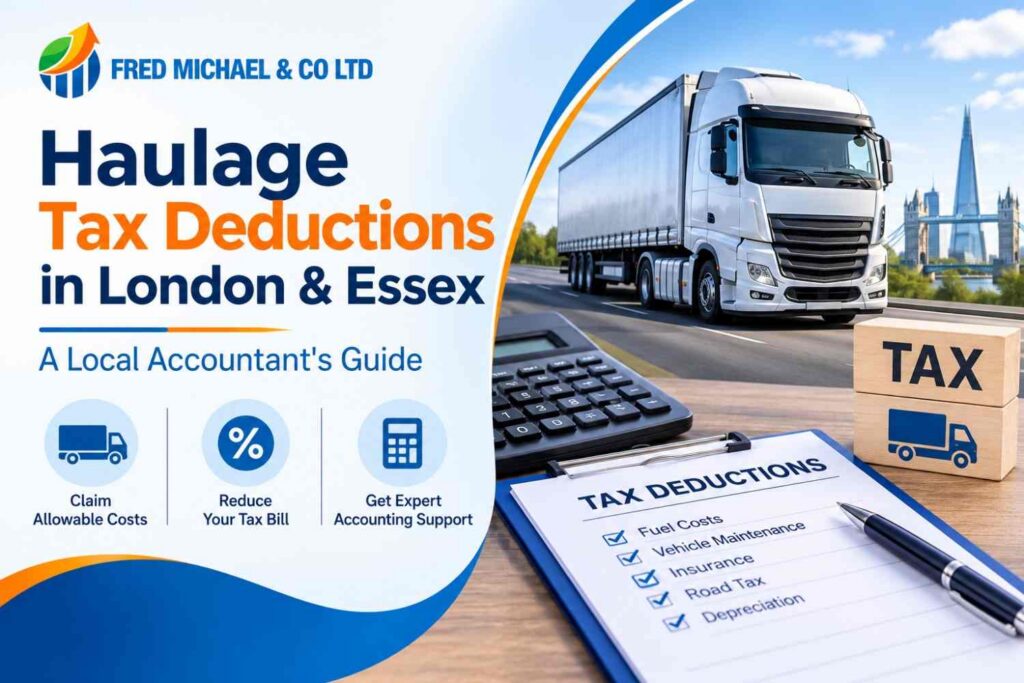
Running a haulage business is demanding. Fuel prices move, vehicles wear out, compliance rules keep changing, and the roads around London and Essex bring extra costs that operators elsewhere rarely see. Many of these costs are tax deductible, yet plenty of hauliers miss claims they are entitled to or claim things they should not. That is why a specialist Haulage accountant in London, or an Essex haulage accountant who knows your routes, can pay for themselves many times over.
How Tax Deductions Work for Haulage Businesses
A tax deduction is a business cost you subtract from your income before tax is calculated. If your company earns £300,000 and has £240,000 of allowable expenses, you pay tax on the £60,000 profit. Many operators use outsourced accounting services to track these costs, and accounting services for small businesses often begin with one question: what can I claim? Pairing deductions with cash flow management and forecasting in London also shows whether a new vehicle is affordable this year.
HMRC’s basic rule is that an expense must be incurred wholly and exclusively for business purposes. Diesel for your article is clearly a business cost; a family holiday is not. Where something is used for both, you can usually claim only the business share. Knowing the full list of tax deductions for UK haulage businesses is the first step towards a lower, fairer tax bill, and a London haulage accounting specialist can walk you through it line by line.
Fuel and Running Costs
Fuel is usually the biggest day-to-day cost, and it is fully deductible when used for business journeys. Keep every receipt or fuel card statement, with the vehicle registration recorded against each purchase, so your tax return accountants in London can file with confidence. Good records also let Tax Planning services in London spot savings before the year ends rather than after. Other running costs you can normally claim include:
- AdBlue and engine oil
- Tyres, including retreads and replacements
- Servicing, MOTs and repairs
- Vehicle washing and cleaning
- Tachograph calibration and analysis
- Breakdown cover and recovery costs
Repairs that restore a vehicle to its previous condition are deductible. Major improvements, such as a new tail lift or a larger body, may count as capital spending instead. A London transport accountant can tell you which treatment applies, and fleet software makes it easier to separate the two.
Vehicle Costs and Capital Allowances
You cannot usually deduct the full price of a lorry or van as an ordinary expense. Instead you claim capital allowances, which give tax relief on vehicles and equipment bought for the business. This is where accounting and bookkeeping services earn their keep, because every purchase must be recorded properly. Many owners also choose to outsource tax preparation services in London so allowances are calculated correctly, while tax return services in London make sure the claim reaches HMRC in the right year.
For haulage businesses, this is often where the biggest savings are found. An accounting service in London that understands transport can show you when to buy, and strong cash flow management and forecasting in London keeps repayments affordable. Outsourced accounting services can then handle the paperwork. Key options include:
- Annual Investment Allowance (AIA): deduct the full cost of qualifying plant and machinery, including goods vehicles, up to the annual limit, currently £1 million.
- Full expensing: 100% first-year relief for limited companies on qualifying new plant and machinery.
- Writing down allowances: relief at a set percentage each year for spending above the limit.
HGVs, vans, trailers, forklifts and tail lifts generally qualify, while cars follow different rules. If you sell a vehicle later, a balancing adjustment may apply, so tell your accountants in London about every disposal. Specialist accounting services for small business clients matter here, because one missed disposal can distort your claim for years.
Buying through hire purchase usually lets you claim capital allowances on the vehicle and deduct the finance interest. If you lease, rental payments are generally deductible. Understanding tax relief on commercial vehicles in UK law, along with UK transport tax relief options, matters before you sign any finance deal.
Insurance, Licences and Compliance Costs
Haulage is heavily regulated, and the cost of staying compliant is deductible. Ask your tax return accountants in London to confirm every renewal is coded properly, and rely on tax return services in London to keep each claim backed by evidence. Typical claims include:
- Goods in transit and motor fleet insurance
- Public and employer’s liability insurance
- Operator licence fees and transport manager costs
- Vehicle Excise Duty and the HGV Road User Levy
- Driver CPC training and licence renewals
- Health and safety training and PPE
These recurring costs add up quickly, and missing one renewal can mean overpaying tax. Early Tax Planning services in London can spread renewals sensibly across the year, and many firms outsource tax preparation services in London to free up time for running the yard.
Read More: Virtual Finance Director UK: Grow Profit and Cash Flow Faster
Costs Specific to London and Essex
Operating around the capital means dealing with charges that rural hauliers rarely face. Many are deductible when they relate to business journeys, and a haulage accountant in Essex will know which apply to your routes. Common examples include:
- Congestion Charge, ULEZ and Low Emission Zone charges: allowable when paid for business use.
- Direct Vision Standard permits: lorries over 12 tonnes need one to enter Greater London, and related safety upgrades may qualify for allowances.
- Dartford Crossing charges: deductible when incurred for business.
- Parking and loading costs: paid bays and yard space near ports are claimable.
Essex hauliers serving Tilbury, London Gateway and Harwich also face port fees, container handling charges and waiting-time costs, all of which belong in your records. The key exception is fines: parking tickets, speeding penalties and unpaid charge notices are never deductible. An Essex transport accountant will keep them separate in your books.
Wages, Subcontractors and Staff Costs
If you employ drivers or office staff, their gross wages, employer’s National Insurance and pension contributions are all deductible, as are agency fees and payments to self-employed subcontract drivers. Training and uniform costs qualify too. Company directors can usually deduct a reasonable salary. A London tax accountant can check driver employment status, which HMRC examines closely.
Subsistence, Travel and Premises
When the journey is genuinely for business, you can usually claim reasonable meal costs on long journeys, overnight accommodation, and secure parking or shower charges at truck stops. Keep a simple log of nights away and the reason for each trip. Commuting between home and your normal workplace is not deductible. Rent, business rates, utilities and security for your yard or depot are also allowable, along with phone, software and professional fees. An Essex tax accountant can help you apply HMRC’s scale rates correctly.
What You Cannot Claim
Knowing what is not allowable matters just as much. Typical exclusions are fines and penalty charges, private fuel use, depreciation (use capital allowances instead), client entertainment, and personal spending from the business account. Where a vehicle is used partly privately, apportion the costs honestly. Haulage tax services in London can help you defend any apportionment if HMRC asks questions.
VAT and Record Keeping
If you are VAT registered, you can usually reclaim VAT on fuel, repairs, tyres and overheads, and on goods vehicles bought for business; cars face tighter limits. HMRC expects records for at least five years, so scan receipts immediately, link accounting software to your bank, and reconcile monthly. Cloud bookkeeping also makes Making Tax Digital submissions far simpler. Haulage tax services Essex teams often see unclaimed VAT simply because receipts went missing.
Accounting for Construction & CIS Industry
Many haulage firms also work with the construction trade, either directly or for contractors. If you do, the Construction Industry Scheme (CIS) may affect how you are paid and what is deducted. Our Accounting for Construction & CIS Industry service covers CIS registration, monthly returns and refund claims alongside your haulage accounts. For London business tax advice, our team looks at both sides of your trade, while Essex business tax advice keeps regional contracts compliant.
Read More: Small Business Financial Advice UK: Everything Business Owners Should Know
Common Mistakes Haulage Businesses Make
The most frequent errors we see include failing to claim capital allowances, mixing private and business spending, claiming fines, losing receipts for fuel and charges, misjudging driver employment status, and leaving bookkeeping to the last minute. Each one can cost money through overpaid tax, penalties or interest. A monthly review of your accounts catches most of them early. Specialist London fleet accounting and Essex fleet accounting help fleets avoid these traps, while accounting services for haulage businesses keep every claim evidence-based.
Get Personalised Accounting Support from Fred Michael & Co Ltd
Haulage tax deductions can make a difference to profit, especially in London and Essex where operating costs run higher than average. Claim everything you are entitled to, but only what you can prove. Rules and allowance limits change, so check GOV.UK or take advice before major purchases. Reliable London transport tax advice and Essex transport tax advice can save thousands before you buy your lorry. This article is general information, not personal tax advice. Fred Michael & Co Ltd works with owner-drivers, small fleets and growing transport and construction businesses across London and Essex. We help with:
- Accounting for Construction & CIS Industry
- Capital allowances, VAT and payroll
- Bookkeeping and year-end accounts
- Tax returns for owners and directors
Contact Fred Michael & Co Ltd today to book a free, no-obligation consultation and find out how much tax you could save.