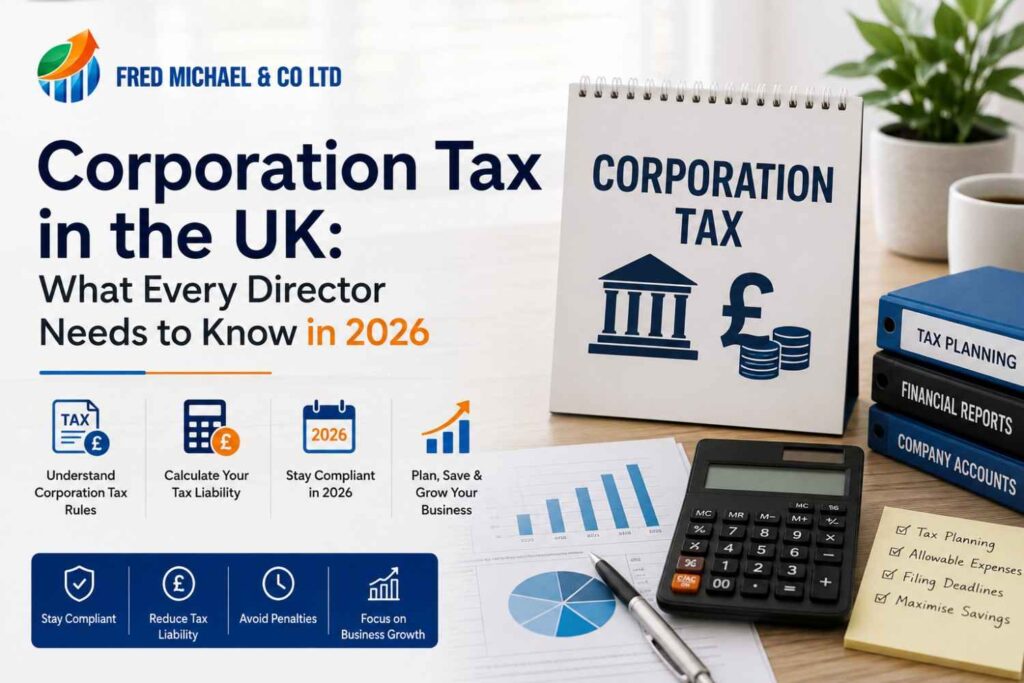
Running a limited company in the UK means corporation tax is one of the most important financial obligations you will face as a director. Yet despite its significance, many directors still find the rules confusing, especially when it comes to rates, deadlines, reliefs, and legal ways to reduce what the company owes. This article covers everything you need to know about corporation tax in 2026, written clearly and practically for company directors managing their own tax affairs or working with a provider of bookkeeping and accounting services.
Corporation tax affects every profitable limited company operating in the UK, regardless of size, sector, or how long the business has been trading. Unlike personal tax, which many directors are already familiar with, corporation tax comes with its own set of rules around accounting periods, payment deadlines, and allowable deductions that don’t always align with what you might expect. Getting it wrong, whether through late filing, missed reliefs, or simple miscalculation, can result in unnecessary penalties or a higher tax bill than necessary. Understanding the fundamentals now, before deadlines creep up on you, puts you in a far stronger position to plan ahead, stay compliant, and make the most of every legitimate opportunity to reduce your company’s tax liability throughout the year.
What Is Corporation Tax and Who Pays It
Corporation tax is the tax your limited company pays on its taxable profits. It is charged on profits from trading activities, income from investments, and any chargeable gains made when selling assets. Importantly, it is a company-level tax, not a personal one. As a director, you are not personally liable for your company’s corporation tax. You are taxed separately on any salary or dividends you draw from the business.
Limited companies registered in the UK are the primary payers of corporation tax, but it also applies to certain other organisations including clubs, societies, and associations. If you are a sole trader or in a partnership, you pay income tax on your profits instead. Self employed tax planning in the UK differs significantly from corporation tax planning, and directors who have recently moved from self employment to running a limited company often find this distinction one of the most important adjustments to make.
Even if your company makes no profit in a given accounting period, you may still have a filing obligation. If HMRC issues a notice to file, you must submit a Company Tax Return, known as a CT600, regardless of whether any tax is owed. Dormant companies are not automatically exempt from this requirement.
Read More: The Ultimate Guide to Modern Bookkeeping for UK Businesses
Corporation Tax Rates in 2026
The rate your company pays depends on how much taxable profit it makes in its accounting period. For 2026, the structure remains unchanged from the two tier system introduced in April 2023. Companies with taxable profits up to the lower threshold pay at the small profits rate. Companies with profits above the upper threshold pay at the main rate. Companies with profits falling between the two thresholds benefit from marginal relief, which gradually increases the effective rate rather than applying a sudden jump.
The practical effect of marginal relief is that the effective marginal rate on profits within this band is higher than either the small profits rate or the main rate individually. This is a point many directors overlook when forecasting their tax liability, and it can lead to unexpected bills if the company’s profits grow into this range without a revised tax estimate in place.
One further complication worth understanding is the associated companies rule. If you control more than one limited company, the profit thresholds are divided between all associated companies. This means a director with two associated companies effectively faces lower individual thresholds for each, potentially pushing both into higher rate territory even if each company’s individual profits appear modest. A chartered accountant in London or elsewhere can help you model the effect of associated company rules on your specific group structure and plan accordingly.
How Corporation Tax Is Calculated
Your company’s taxable profits are not simply your accounting profit. To arrive at the taxable figure, certain adjustments are made to the profit shown in your accounts. Some expenses that appear in your accounts are not allowable for corporation tax purposes, such as business entertainment costs. Conversely, capital allowances are available for tax in a way that differs from standard accounting depreciation.
Capital allowances replace the depreciation charge in your accounts for assets like equipment, vehicles, and machinery. The Annual Investment Allowance currently allows companies to deduct the full cost of most qualifying plant and machinery purchases in the year they are incurred, up to a generous upper limit. This makes the timing of capital purchases a legitimate and effective tool in corporation tax planning in the UK.
CT600 Filing and Payment Deadlines
Your Company Tax Return must be filed with HMRC within twelve months of the end of your accounting period. Corporation tax payment, however, is due earlier at nine months and one day after the period ends. This gap catches many directors out. Missing the payment deadline brings interest charges from HMRC from the very next day. Missing the filing deadline triggers an automatic penalty, with further charges if the delay continues.
It is also worth noting that since March 2026, HMRC’s free CT600 filing service has been permanently closed. All companies must now file using approved commercial software or through a professional. This change has caught some directors off guard, particularly those who had previously filed directly through the HMRC portal. Reliable management accounting services in London can help you keep accurate records throughout the year. Good bookkeeping and accounting services ensure your figures are accurate and your deadlines are never missed.
Legal Ways to Reduce Your Corporation Tax Bill
Reducing your company’s corporation tax is entirely legal when done through the reliefs and allowances HMRC has built into the system. The following are among the most effective year end tax planning strategies available to directors in 2026.
Director pension contributions. Employer contributions made by the company into a director’s pension are deductible from taxable profits, provided they are paid before the company’s year end and meet HMRC’s test of being wholly and exclusively for the purposes of the trade. For owner managed companies, this represents one of the most tax efficient ways to extract value while reducing the corporation tax liability at the same time. A personal tax advisor London based or nationwide can help you determine the right contribution level for your circumstances.
Director remuneration planning. The salary paid to a director is an allowable deduction from profits, reducing taxable income. However, the most tax efficient balance between salary, bonuses, and dividends depends on the interaction between corporation tax, income tax, and National Insurance. Reviewing this structure annually is good practice, especially given the changes to dividend tax rates introduced in recent years.
Timing of capital expenditure. Purchasing qualifying plant and machinery before your accounting year end can bring forward a significant tax deduction through the Annual Investment Allowance. For a company in the marginal relief band, a well timed capital purchase could shift profits below the lower threshold entirely, reducing the effective rate applied to all profits for that period.
Research and Development tax relief. Companies spending money on developing new products, processes, or services may be able to claim R&D tax relief, deducting a higher proportion of qualifying expenditure than the actual cost. Many directors are unaware their activities qualify. The regime has undergone significant reform in recent years, so professional advice on eligibility is worthwhile.
Claiming all allowable expenses. Ensuring your company claims every legitimate business expense is one of the simplest and most overlooked ways to reduce taxable profit. This covers a wide range of costs including professional fees, insurance, business travel, and relevant staff training, provided each expense is incurred wholly and exclusively for the purposes of the trade.
Beyond Corporation Tax: The Wider Picture for Directors
Corporation tax is only one part of the tax landscape for a limited company director. Other obligations and opportunities also deserve attention as part of a joined up approach to managing your personal and business finances.
Capital gains tax planning in the UK becomes relevant when you sell business assets, shares, or investment property. A chartered financial advisor in London can help you time a disposal and structure it in a way that makes full use of available reliefs.
Inheritance tax advice in London is increasingly sought by directors whose business has grown significantly in value. Business Property Relief can reduce or eliminate inheritance tax on qualifying business assets, but the planning needs to be in place well in advance. Both areas sit most effectively within a broader strategy delivered by an accounting service in London that covers all aspects of your business and personal tax position together.
Making Tax Digital for Corporation Tax
Making Tax Digital for Corporation Tax is on the government’s roadmap, requiring companies to keep digital records and submit data to HMRC more frequently. A mandatory start date has not yet been confirmed for most companies, but engaging an accounting service in London now ensures your records will already be in the right format when the requirement arrives.
Why Working With Professionals Makes a Difference
Corporation tax involves many moving parts. Applying marginal relief correctly, timing deductions, navigating associated company rules, and staying on top of deadlines all require careful attention, and the rules change from year to year.
Tax planning services in London are built around helping directors review their position in full, confirming that all reliefs have been claimed and that HMRC compliance is maintained. Whether you need support with your CT600 or access to management accounting services in London that keep your records audit ready year round, working with qualified professionals is one of the most cost effective decisions a director can make.
Final Thoughts
Corporation tax is one of the most significant costs a limited company faces, but informed planning can make a genuine difference to what you actually pay. Understanding the rate structure, knowing your deadlines, and making full use of available reliefs are the foundations of a well managed tax position. The decisions you make about remuneration, capital investment, and pension contributions all feed directly into your liability. Accessing tax planning services in London that are tailored to your specific circumstances, or working with a chartered financial advisor in London who can coordinate your personal and business finances, is one of the most valuable steps you can take for the long term health of your business.
At Fred Michael & Co Ltd, we help company directors take the guesswork out of corporation tax, from getting the rate structure and deadlines right to identifying every relief your business is entitled to. Ready to make sure your company isn’t paying more than it needs to? Get in touch with Fred Michael & Co Ltd today and let us build a tax plan that works for both your business and your personal finances.
How can a limited company director legally reduce their corporation tax bill?
Directors can reduce corporation tax through employer pension contributions, timing capital expenditure before the year end, claiming all allowable business expenses, and exploring R&D tax relief. Reviewing your salary and dividend balance annually is also one of the most effective year end tax planning strategies available.
What is marginal relief and does my company qualify for it?
Marginal relief applies when your company’s taxable profits fall between the lower and upper corporation tax thresholds. It gradually increases the effective rate rather than jumping straight to the main rate. If your company has associated companies, the thresholds are divided between all of them.
What is the corporation tax rate in the UK for 2026?
In 2026, companies with profits up to the lower threshold pay 19%. Those above the upper threshold pay 25%. Profits falling between the two thresholds benefit from marginal relief, which gradually increases the effective rate rather than applying a sudden jump.
Does a dormant or loss-making company still need to file a corporation tax return?
Yes. If HMRC issues a notice to file, the CT600 must be submitted even with no profit or activity. Late filing penalties still apply. Since March 2026, HMRC’s free filing service is closed, so companies must now use approved software or a qualified accountant.
When does corporation tax need to be paid and when must the CT600 be filed?
Corporation tax payment is due nine months and one day after your accounting period ends. The CT600 filing deadline is twelve months after the same date. These are separate deadlines, and confusing the two is one of the most common and costly mistakes directors make.