
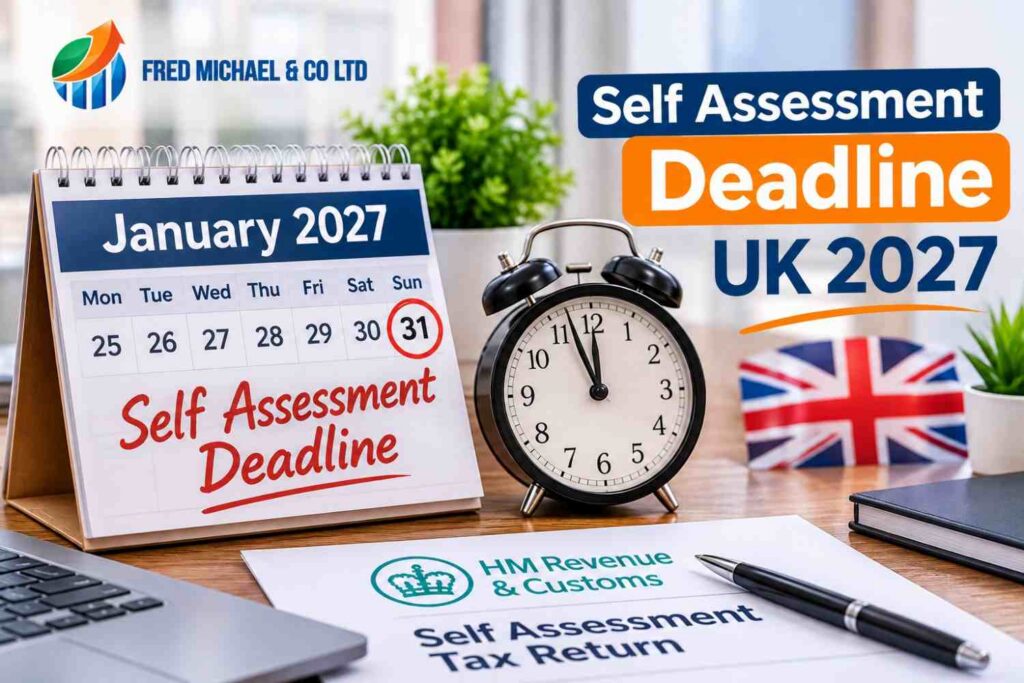
The Self Assessment tax return deadline 2027 falls on 31 January. By 11:59pm that night, HMRC must have your online tax return and the tax you owe. Miss it and the penalties start the very next day, even if you owe nothing. It is the Self Assessment deadline for business owners that most often catches them out, and with around 12 million people expected to file by then, according to HMRC, the January rush is as busy as ever.
There is a catch that trips up many business owners: the return due on 31 January 2027 covers the 2025/26 tax year, which ran from 6 April 2025 to 5 April 2026. Whether you rely on accounting and bookkeeping services for your records or use accounting services for small business owners to stay compliant, the same deadline applies. Sound cash flow management and forecasting in London matters too, because the January bill can be large.
The Self Assessment dates to put in your diary
These are the key dates for the 2025/26 return and the payments that follow it, and they sit alongside your other obligations as an employer. If you keep your own records, good bookkeeping and accounting services will make each date easier to meet, and outsourced accounting services can track them for you. If you also run staff, payroll services London businesses trust can keep PAYE in step with your personal tax, and payroll management services London teams rely on can remove the monthly admin. The key dates are:
- 5 October 2026: the Self Assessment registration deadline UK newcomers must meet. This has now passed, so register straight away if you have not.
- 31 October 2026: the deadline for paper returns for 2025/26. This has also passed, so file online.
- 30 December 2026: if you owe less than £3,000 and file online by this date, you can usually ask HMRC to collect the tax through your PAYE tax code instead.
- 31 January 2027: the online Self Assessment filing deadline 2027, plus any balancing payment for 2025/26 and your first payment on account for 2026/27. This is also the Self Assessment tax payment deadline 2027 for the tax you owe.
- 31 July 2027: your second payment on account for 2026/27 is due.
Beyond the UK Self Assessment tax deadlines 2027 brings, the 2026/27 return follows a similar pattern, with the online return and payment due by 31 January 2028.
Do you need to file a Self Assessment return?
Most business owners do, and the tax return deadline for sole traders 2027 is the same 31 January as for everyone else. The Self Assessment tax return requirements for small businesses depend on how your business is set up. You generally need to file if you:
- are self-employed as a sole trader and earned more than £1,000 in gross income, so a Self Assessment tax return for self-employed people is required;
- are a partner in a business partnership;
- are a landlord with rental income above the relevant limits;
- have other income that was not taxed at source, such as dividends from your own company, or capital gains from selling assets, including cryptoassets.
Limited company directors are often caught too. Even if your company files its own Corporation Tax return, you may still have to file a personal return for dividends, benefits or other untaxed income. Directors who pay themselves a salary through the company need payroll services London accountants can run alongside the return. Many owners compare outsourced accounting services with in-house help, and a trusted accounting service in London can explain how salary and dividends interact. Payroll services for small business London owners need should be fixed-fee, so you always know the cost.
Payments on account: the part that surprises business owners
Many business owners are caught out not by the return, but by payments on account. These are advance payments towards next year’s bill. You normally make them if your last Self Assessment bill was over £1,000 and you did not pay most of your tax at source.
Each payment is half of your previous year’s bill. They fall due on 31 January during the tax year and 31 July after it. The first payment on account for 2026/27 is therefore due on 31 January 2027, on the same day as your balancing payment for 2025/26, which makes it the key payments on account deadline 2027. Two large sums can leave the account at once, so cash flow management and forecasting in London is worth doing early, and a virtual finance director in London can turn the numbers into a simple monthly savings plan, while accounting services for small business clients often use can show how a fall in profit changes the amounts.
Here is an example of how this plays out, the kind of calculation an accounting service in London would run for you and a virtual finance director in London would build into your cash forecast. Suppose your 2025/26 tax bill is £10,000 and you already paid £6,000 on account towards it. On 31 January 2027 you would pay:
- a balancing payment of £4,000 for 2025/26; plus
- a first payment on account of £5,000 for 2026/27.
That is £9,000 in a single day, followed by a further £5,000 on 31 July 2027.
Penalties and interest if you miss the deadline
GOV.UK sets out the penalties clearly, and HMRC late tax return penalties 2027 build quickly. Late filing penalties are:
- 1 day late: an immediate £100 penalty, even if you owe no tax.
- 3 months late: additional daily penalties of £10 a day, up to a maximum of £900.
- 6 months late: a further penalty of 5% of the tax due or £300, whichever is greater.
- 12 months late: another penalty of 5% of the tax due or £300, whichever is greater.
Late payment is penalised separately. You are charged 5% of the unpaid tax at 30 days, a further 5% at six months and another 5% at 12 months. On top of that, HMRC charges daily interest on the overdue amount at the Bank of England base rate plus 4%.
How to avoid Self Assessment late filing penalties comes down to three habits: file early, pay on time and speak to HMRC if you cannot. If you cannot pay in full, do not wait. The Self Assessment tax payment options UK taxpayers can use range from bank transfer and online debit card payments to a Time to Pay arrangement, which you should ask HMRC about before the deadline.
Making Tax Digital for Income Tax is now part of the picture
The biggest change for sole traders and landlords is Making Tax Digital (MTD) for Income Tax. It became mandatory on 6 April 2026 for people with qualifying income above £50,000. It extends to those with qualifying income above £30,000 from 6 April 2027. HMRC decides which group you fall into using the income on your Self Assessment return, so the return you file by 31 January 2027 matters twice over.
If you fall into the 2027 group, you will need to keep digital records in compatible software and send quarterly updates to HMRC. Government guidance indicates that the first quarterly update for those starting in April 2027 is due by 7 August 2027.
MTD applies to individuals, not limited companies, and if you are already in MTD you must still complete your Self Assessment return and pay any tax due by 31 January 2027.
Read More: 5 Budget Changes London Business Owners Should Act on Before April 2027
A practical checklist before 31 January 2027
- Gather the documents needed for Self Assessment tax returns: sales, expenses, bank statements, dividend vouchers and any capital gains paperwork.
- File early and check the figure. A return filed in December gives you weeks to arrange payment.
- Put money aside each month for your tax bill, including payments on account.
Final Thoughts
The Self Assessment deadline in 2027 is simple to state but costly to ignore. Filing by 31 January, paying on time, understanding your payments on account and preparing for MTD will keep you in control of your tax position. The cheapest day to file is almost always today.
If you would rather hand the work to professionals, Fred Michael & Co Ltd can provide Self Assessment tax services in London, from Self Assessment tax preparation in the UK to payments on account planning and MTD readiness. As small business tax accountants in the UK, we also offer tax return services for small businesses in London that fit your budget. Contact Fred Michael & Co Ltd today to book your Self Assessment review before the January rush, so that you can file with confidence and avoid penalties.