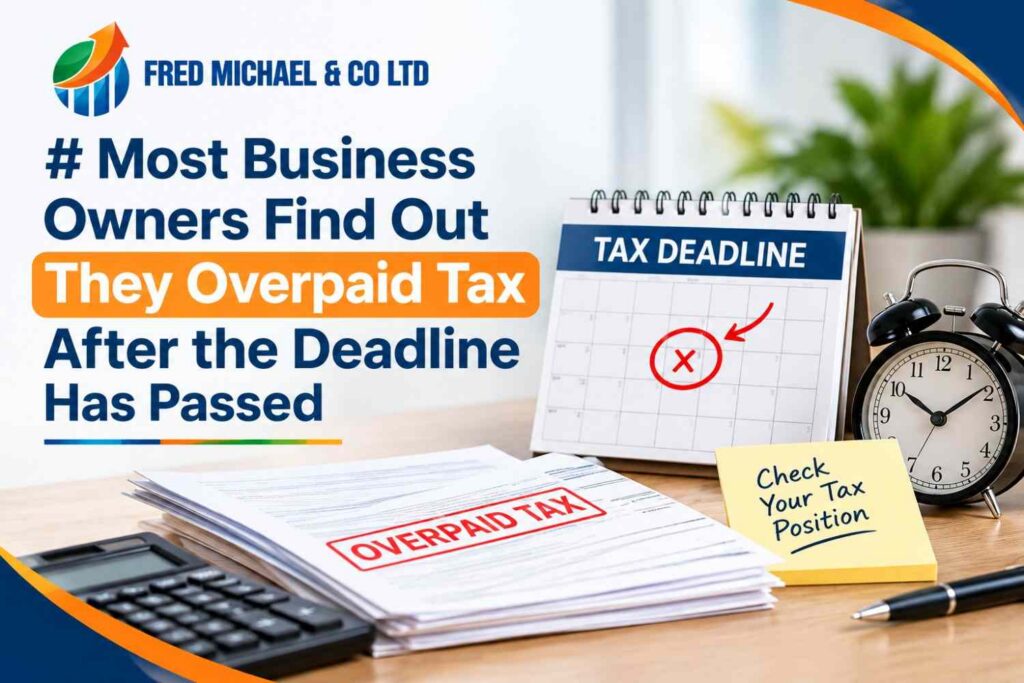
Every year, thousands of business owners file their tax returns, pay what they believe they owe, and move on with a sense of relief. Then, weeks later, an accountant spots a missed allowance, or a routine review shows the figures were never as accurate as they seemed. The business paid more than it needed to, and the deadline to put things right has already gone. Learning to avoid overpaying business tax is far easier before that moment arrives than after it.
Overpaying is more common than most people think, and it rarely comes from carelessness. Tax rules are complex, deadlines are tight, and running a company leaves little time for the fine print. That is why many owners rely on accounting and bookkeeping services for everyday accuracy, and on an experienced accounting service in London when bigger decisions arise. The right Tax Planning services in London, together with dependable tax return services in London and thoughtful tax return accountants in London, can turn a rushed annual filing into a considered, year-round process.
Why Overpaying Tax Is So Common
Most business owners did not start their company to become tax experts. They set out to deliver a product or service, so tax sits at the bottom of the priority list until a deadline looms. Many therefore lean on Bookkeeping and Accounting Services to keep records straight, choose accounting services for small business that fit their budget, or use outsourced accounting services so specialists handle the work. Others prefer to outsource tax preparation services in London so the filing is never left to chance. Even then, the most valuable questions often go unasked.
When the deadline arrives, the focus shifts to one goal: file on time and avoid penalties. Records are gathered in a rush, figures are estimated, and returns go in on the assumption that everything is probably fine. These are among the most common business tax mistakes, and the fear of a late-filing penalty is immediate while the cost of an overpayment is invisible. Nobody sends a letter saying, “You paid too much.” Underpaying triggers penalties, interest, and letters; overpaying triggers nothing, so the money simply leaves your account.
That is where professional support earns its keep. A second pair of eyes on every figure catches what a rushed owner misses, and cash flow management and forecasting in London shows how much tax is likely to fall due before the bill arrives. A virtual finance director in London can connect those forecasts to real decisions, while an accounting service in London and Tax Planning services in London keep the underlying data clean and support small business tax planning strategies that work all year.
Common Ways Businesses Overpay Tax
Overpayments come from a handful of recurring patterns, and spotting them early is half the battle. It starts with knowing which tax deductions for small businesses UK rules allow, which business expenses tax deductions UK owners forget most often, and what counts as allowable business expenses UK law recognises.
Missed Deductions and Allowable Expenses
Professional fees, software subscriptions, business travel, a share of home-working costs, marketing, training, and insurance are often overlooked, and small amounts add up quickly. Reliable accounting and bookkeeping services will review every expense category, tax return services in London will make sure nothing legitimate is left off the return, and tax return accountants in London will confirm eligibility before filing. Pairing Bookkeeping and Accounting Services with accounting services for small business that understand your sector keeps those claims accurate all year.
Unclaimed Reliefs and Allowances
Reliefs exist to encourage investment and growth, including capital allowances on equipment, research and development relief, and incentives for training staff, yet many companies assume they apply only to large corporations. With outsourced accounting services, each claim can be reviewed regularly, and firms that outsource tax preparation services in London often uncover relief they would never have spotted alone. Cash flow management and forecasting in London shows how those savings strengthen working capital, and a virtual finance director in London ties it all together without a full-time hire.
The cost of missed tax relief claims for businesses can be substantial, and because business tax relief and allowances change often, something unavailable last year may apply now.
Poor Record-Keeping
You cannot claim what you cannot prove. Lost receipts and unrecorded cash costs understate expenses and inflate profit, and higher profit means a higher bill. Good records are not just a compliance duty; they are the foundation of an accurate return and the first defence against paying too much.
Incorrect Classifications
An asset may be treated as a repair rather than a capital purchase, or income recorded in the wrong period. Business tax return errors and corrections like these can push profit into a higher bracket or delay a deduction that should have been claimed immediately. The numbers may be right while the treatment is wrong.
Payments on Account and Unused Losses
When advance payments are based on last year’s profit, a business whose income has fallen can pay far too much. Losses can also be offset against other periods, yet many owners never use them.
Read more: MTD Deadline 7 November: What You Must Submit Now
Why Most Owners Only Find Out After the Deadline
- There is no warning signal. Tax authorities collect what is owed; they do not flag the tax-saving opportunities for business owners that were missed.
- Hindsight is the only audit. Many businesses review their position only after the year closes, when options such as timing purchases, pension contributions, or restructuring payments have already gone.
- Information arrives late. A new relief or advice from a peer may surface weeks after filing. The knowledge is useful, but it arrives too late for that return.
- Owners rely on assumptions. Basic software records transactions but does not advise on tax planning. Compliance and optimisation are different services.
The Real Cost of Overpaying
Every pound paid unnecessarily could have funded stock, wages, or marketing, and for small businesses cash flow often decides growth. If the same error repeats each year, a few thousand pounds becomes a five-figure problem, and the frustration of an avoidable mistake adds to it.
There is also a hidden cost in opportunity. Money paid in excess tax cannot be reinvested in equipment, hiring, or marketing, so repeated overpayments quietly hold a business back from the growth it is capable of.
How to Avoid Overpaying Tax
Most overpayments are preventable, and these habits show how to reduce business tax liability.
- Keep accurate records all year. Record expenses as they happen and store receipts digitally, so every legitimate deduction can be evidenced later.
- Plan early. Tax planning before the financial year ends lets you time purchases and use allowances while they still count, rather than discovering them afterwards.
- Review advance payments. If profits drop, reduce instalments and keep cash in the business instead of lending it to the tax authority.
- Stay informed. Reliefs and thresholds change regularly, so review updates each quarter or work with someone who does it for you.
- Separate business and personal money. A dedicated account keeps claims clean and makes allowable costs far easier to identify.
- Ask for proactive advice. Small business accounting and tax advice should look for savings, not only file the return, and professional tax planning services for businesses can build this into every year.
Read More: MTD Penalties 2026: Will You Be Fined for a Late Update
Can You Recover Tax Already Overpaid?
Often, yes. Business tax overpayment recovery is possible for a limited period, and the exact limits depend on the tax involved. Claiming a business tax refund may mean amending a past return, and a corporation tax overpayment refund follows its own process. Knowing how to claim back overpaid tax from HMRC, and the HMRC tax repayment claims deadline that applies, is essential, because a missed window means the money is lost for good. An HMRC tax refund for businesses is never automatic, so ask an adviser to review past returns. The sooner you act, the more likely you are to stay inside the time limits.
Specialist Support for Construction and CIS Businesses
Accounting for Construction & CIS Industry clients brings its own overpayment risks. Deductions taken under the Construction Industry Scheme can exceed what is due, and unclaimed costs such as tools, materials, and mileage quietly increase the bill. Specialist support reviews deductions, reclaims overpayments, and keeps records ready for every return. Many contractors and subcontractors in the industry overpay simply because nobody has checked how deductions, expenses, and claims fit together across the tax year. Whether you are a main contractor or a subcontractor, a tailored review keeps you compliant while protecting your margins.
Book Your Tax Review Today
Don’t let another deadline pass before you find out whether you have overpaid. The team at Fred Michael & Co Ltd will look through your returns, expenses, and reliefs, and show you where you could keep more of what your business earns.
- Talk to a specialist about your current tax position
- Find out whether past returns can still be reviewed
- Leave with clear, practical next steps
Contact Fred Michael & Co Ltd today to arrange your consultation, and make sure every pound you pay is one you genuinely owe.
Final Thoughts
Overpaying tax does not make you a poor business owner; it means the system is complicated and nobody is watching your savings. The businesses that keep more of their profit look at their tax position early, ask the right questions, and rely on expert guidance throughout the year, not just at the deadline. You do not have to wait until it is too late: a proactive approach protects your cash flow and gives you confidence that every pound you pay is one you genuinely owe. Whether you run a small start-up or an established company, the principle is the same: the earlier you look, the more you can save.
Don’t let another deadline pass before you find out whether you have overpaid. Contact Fred Michael & Co Ltd today for a thorough review of your tax position, and let our team help you keep more of what your business earns.
Frequently Asked Questions
How do I know if my business has overpaid tax?
Common signs include profits that fell while your advance payments stayed the same, expenses that never made it onto the return, or reliefs that were never reviewed. A review of past returns against your records is the most reliable check. Overpayments rarely trigger a letter from HMRC, so they usually only come to light when someone looks for them.
Can I get a refund if my business paid too much tax?
Yes, in many cases. How you claim depends on how much time has passed. The time limit for amending a return, for an individual or a company, is usually one year from the deadline for submitting it. After that date, the claim has to go through an overpayment relief claim. Refunds are not automatic, so you need to ask.
How long do I have to claim back overpaid tax from HMRC?
What is overpayment relief?
It is the route for reclaiming tax outside the tax return once the amendment window has passed. A person can claim it to recover overpaid income tax, CGT, Class 4 NIC or corporation tax, or to reduce an excessive assessment. HMRC will reject a claim that is not made in the required format or that falls under a listed exclusion.
Can I still claim if the deadline has already passed?
Sometimes. There is no specific legislation giving the commissioners discretion to accept a late claim, but HMRC may still accept one on a discretionary basis. There is also a narrow exception: special relief has no time limit, but it only applies where HMRC has made a determination of tax due. Do not rely on either, and treat the deadline as firm.