
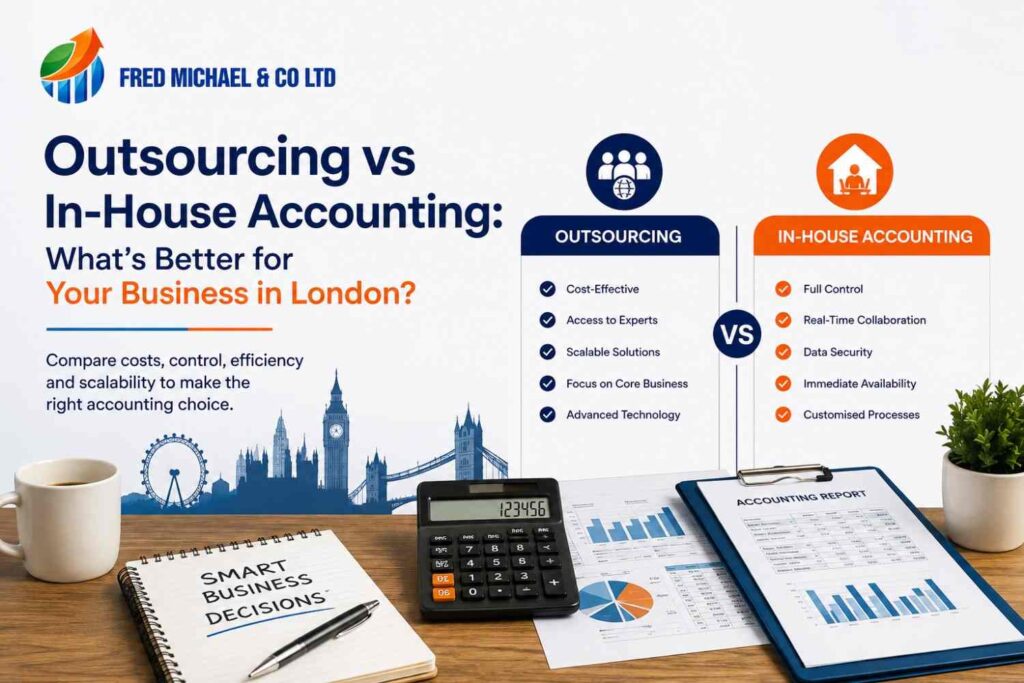
At some point, almost every growing business faces the same question: keep accounting in-house, or hand it over to an outside firm? It’s rarely simple. Both options have real advantages, and the right answer depends on your business size, budget, growth stage, and how much control you want over your day-to-day finances. In-house accounting gives businesses direct access to their financial team and can make communication easier. However, maintaining a dedicated team can increase employment, training, software, and management costs. Outsourcing, on the other hand, can provide access to experienced professionals without the expense of maintaining a large internal department.
This article explores the key differences between outsourced and in-house accounting, including the benefits and limitations of each approach. It also explains what businesses should consider before making a decision, from cost and flexibility to expertise and scalability. For businesses seeking additional support, outsourced accounting services in London can offer a practical way to manage financial tasks while allowing business owners to focus on growth and operations.
What Is In-House Accounting?
In simple terms, in-house accounting means employing your own accountant, bookkeeper, or finance team directly. They work exclusively for you, sit within your organisation, and typically become deeply familiar with your operations and financial history over time.
This is the traditional model most people picture a dedicated employee (or team) handling payroll, invoicing, tax filings, financial reporting, and day-to-day bookkeeping.
What Is Outsourced Accounting?
Outsourced accounting means bringing in an external firm or specialist to handle some or all of your accounting functions, rather than hiring staff directly. This ranges from a bookkeeper handling monthly reconciliations to a full outsourced finance department managing payroll through strategic planning.
Outsourced providers typically work with multiple clients at once, bringing broader experience and access to more sophisticated tools than a single in-house hire might have.
Read More: What is Cash Flow and how can it help me?
Key Differences Between Outsourcing and In-House Accounting
The core distinction in outsourced accounting vs in-house accounting comes down to control versus flexibility. An in-house team is embedded full-time, available on demand, and answerable only to you. An outsourced provider offers specialist expertise and scalability, but with less day-to-day presence and shared attention across multiple clients.
Cost structure also differs when weighing in-house accounting vs outsourcing. In-house accounting involves fixed costs salary, benefits, training, software, office space regardless of workload. Outsourced accounting is usually priced around the actual scope of work, flexing as your needs change.
Benefits of In-House Accounting
- Full control and visibility. Because an in-house accountant works directly within your business, you have immediate access and full oversight of your finances.
- Deep familiarity with your business. Over time, an in-house team builds detailed knowledge of your operations and financial history, making them faster at spotting anomalies.
- Immediate availability. Need a quick answer or an urgent adjustment? An in-house accountant is typically just a desk away, without scheduling a call with an external firm.
- Stronger internal alignment. Being part of the team often means better alignment with company culture and communication style.
Drawbacks of In-House Accounting
- Higher fixed costs. Salaries, benefits, pension contributions, training, and software licences add up and remain constant even during quieter periods with less work.
- Limited expertise range. A single in-house accountant, or even a small internal team, can’t always match the breadth of specialist knowledge an outsourced firm builds up across many businesses and industries.
- Recruitment and retention risk. Hiring the right person takes time and money, and losing a key finance employee can leave a business scrambling to fill the gap, especially during critical periods like year-end reporting.
- Less scalability. As your business grows or shrinks, adjusting an in-house team’s size can be slow and costly compared to changing the scope of an outsourced arrangement. This is one reason in-house accounting for small business owners is less common than it once was, fixed costs rarely match a fluctuating workload.
Benefits of Outsourced Accounting
- Cost efficiency. Outsourcing typically removes the fixed costs of a full-time salary, replacing them with a fee that reflects the actual work done considerably more affordable for many small and mid-sized businesses.
- Access to broader expertise. Outsourced firms usually employ specialists across bookkeeping, tax, payroll, and management accounting, giving you a wider skill set than a single in-house hire could realistically offer. Many businesses combine general bookkeeping with more specific support, such as outsourced payroll services in London for accurate, on-time wage processing, or outsource tax preparation services in London to keep filings compliant.
- Scalability. As your business grows, an outsourced provider can typically scale services up or down without the delays and costs of hiring or letting go of staff.
- Reduced compliance risk. Reputable outsourced accounting firms stay current with changing tax laws, reducing the risk of costly mistakes especially valuable when using outsource tax preparation services in London during busy filing periods.
- Access to better tools. Outsourced providers often use advanced software and processes refined across many clients, improving accuracy compared to smaller, less resourced setups. Some firms also offer outsourced credit control services in London, helping businesses chase overdue invoices without dedicating an internal employee to the task.
Drawbacks of Outsourced Accounting
- Less day-to-day presence. An outsourced team isn’t physically in your office, which can make quick conversations harder and may slightly slow down urgent requests.
- Shared attention. Outsourced providers manage multiple clients at once, so your business isn’t always their sole focus, even if service levels remain strong.
- Data security considerations. Sharing sensitive financial information with an external party requires trust and due diligence worth confirming a provider’s data protection practices before signing on. This is one of the most commonly cited accounting outsourcing risks, alongside consistency concerns if staff at the provider change.
- Less inherent business context. An outside firm may take longer to build the same institutional knowledge an in-house employee develops by being present every day.
Cost Comparison: Outsourcing vs In-House
Cost is often the deciding factor for smaller businesses. A full-time in-house accountant’s salary, combined with benefits, National Insurance contributions, training, and software, is a significant fixed monthly expense, one that continues whether there’s a heavy workload or a quiet month.
Outsourced accounting, by contrast, is typically structured around the services required, whether a fixed monthly retainer or a fee based on transaction volume. For many small and growing businesses, working with a provider of outsourced accounting services in London results in lower overall costs, particularly when the business doesn’t yet generate enough work to justify a full-time salary. Very large organisations sometimes find a well-resourced in-house team, once at scale, more cost-effective than an extensive outsourced arrangement.
When Does Outsourcing Make the Most Sense?
Outsourcing tends to be the stronger option for small businesses and startups without a budget for a full-time finance team, where outsourced accounting for small business needs makes far more sense than a full hire. It also suits businesses with seasonal or fluctuating workloads, companies needing specialist support payroll, credit control, or tax planning without hiring separately for each function, and those looking to convert fixed overhead into a flexible expense. For founders exploring accounting options for startups, outsourcing is often the natural starting point.
When Does In-House Accounting Make the Most Sense?
In-house accounting tends to work better for larger businesses with complex, high-volume operations, companies requiring constant, real-time oversight, and organisations where deep institutional knowledge and close team integration are critical. It also suits businesses with the budget to justify a dedicated finance function, and industries with sensitive processes that benefit from full internal control.
Is a Hybrid Model an Option?
Many businesses don’t have to choose one model exclusively. A hybrid approach keeping certain functions in-house while outsourcing others is increasingly common. A business might keep a part-time bookkeeper on staff for daily transactions while outsourcing tax planning, payroll, or higher-level management accounting to a specialist firm.
This can offer the best of both worlds: day-to-day familiarity and control, paired with specialist expertise for complex needs, without the cost of building an entire finance department internally. For businesses weighing up the best accounting solution for growing businesses, a hybrid model offers flexibility to scale support as the company expands.
How to Decide What’s Right for Your Business
A few practical questions can help clarify the decision. What’s your budget if a full-time salary and benefits package isn’t currently justified by your workload, outsourcing is likely the more sensible starting point. How complex are your finances, straightforward needs may suit outsourcing, while complex, high-volume transactions might benefit from in-house oversight. How much control do you need day-to-day if real-time, hands-on management is essential, an in-house presence may be worth the investment. How fast are you growing rapidly scaling businesses often benefit from the flexibility outsourcing provides. And do you need specialist expertise in payroll, credit control, tax preparation, or strategic guidance that an outsourced firm may offer more readily than a single in-house hire.
Final Thoughts
There’s no universal answer to whether outsourcing or in-house accounting is better. The right choice depends on your business size, financial complexity, budget, and growth plans. Smaller businesses often find outsourcing more cost-effective and flexible, while larger organisations with complex requirements may benefit from the greater control of an in-house team. For many businesses, a hybrid approach can offer the best of both worlds. This might mean keeping a finance lead internally while outsourcing specialist functions such as outsourced payroll services in London or outsourced credit control services in London when additional expertise is needed.
Whichever approach you choose, the goal remains the same: maintaining accurate, timely financial information that supports confident decision-making. Fred Michael & Co Ltd can help businesses assess their accounting requirements and identify practical ways to manage their financial responsibilities. Ready to find the right accounting approach for your business? Contact Fred Michael & Co Ltd today to discuss your requirements and explore flexible financial support tailored to your business needs.
Frequently Asked Questions
Is outsourcing accounting cheaper than hiring in-house?
Outsourcing is usually cheaper for small and mid-sized businesses because it removes fixed costs like salary, benefits, and training. You pay only for the work required, whereas an in-house accountant’s salary continues regardless of workload, making outsourcing more cost-efficient overall.
What is the main difference between outsourced and in-house accounting?
In-house accounting means employing your own dedicated accountant or team, giving full control and constant availability. Outsourced accounting means hiring an external firm to manage accounting functions, offering broader expertise, flexibility, and lower overhead in return for less day-to-day presence.
Is outsourced accounting safe for small businesses?
Yes, provided you choose a reputable provider with strong data protection practices. Reputable outsourced accounting firms use secure systems, follow compliance standards, and sign confidentiality agreements, making them a safe, practical option for small businesses without dedicated in-house finance teams.
Can I switch from in-house to outsourced accounting later?
Yes, many businesses transition between models as they grow or as needs change. Switching typically involves handing over financial records, granting system access, and agreeing a transition period, allowing outsourced providers to take over smoothly without disrupting day-to-day financial operations.
Do outsourced accountants handle payroll and tax filing too?
Most small outsourced accounting firms offer payroll processing, tax preparation, and compliance filing alongside standard bookkeeping. This means businesses can consolidate multiple financial functions with one provider instead of managing separate specialists, saving time, reducing errors, and simplifying overall financial administration.