Navigating the complexities of the UK tax system can feel overwhelming, especially when you are running a business, managing multiple income streams, or simply trying to stay compliant with HMRC regulations. Every year, thousands of individuals and businesses across the United Kingdom face stress, confusion, and costly penalties simply because they tried to handle their tax obligations alone without the right expertise or support.
This is where professional self-assessment tax return service providers step in to make a real difference. Whether you are a self-employed professional, a landlord, a company director, or a small business owner, working with experienced tax experts not only saves you time but also protects your financial interests in ways you may never have considered.
In this article, we explore how reliable tax return services in the UK safeguard your interests, why more businesses are turning to outsourced payroll services and financial director services, and what you stand to gain by making the switch to professional tax support.
What Is Self-Assessment and Who Needs It?
Before diving into the benefits of professional services, it is important to understand what self-assessment actually means. Income tax self-assessment is a system used by HMRC (His Majesty’s Revenue and Customs) to collect tax from individuals whose income is not automatically taxed through PAYE (Pay As You Earn).
You are typically required to file a self-assessment tax return UK if you:
- Are self-employed or a sole trader earning more than £1,000
- Are a company director
- Earn income from property rentals
- Have income from overseas sources
- Receive dividends or investment income
- Earn over £100,000 per year
- Claim Child Benefit and earn over £50,000
- Have capital gains to report
Filing a personal tax return accurately and on time is a legal requirement. Failure to do so can result in penalties, interest charges, and even HMRC investigations that can disrupt your personal and business finances significantly.
Common Self-Assessment Tax Return Mistakes to Avoid
One of the biggest reasons people seek professional help is to steer clear of costly errors. Understanding self-assessment tax return mistakes to avoid can save you thousands of pounds and a great deal of stress.
1. Missing the Filing Deadline
The online self-assessment deadline is 31st January each year. Missing this date results in an automatic £100 fine, with further penalties accumulating the longer you delay. Many people underestimate how long it takes to gather information and complete the return accurately.
2. Incorrectly Reporting Income
All sources of income must be declared, including freelance work, rental income, dividends, and foreign earnings. Omitting even a small income stream can trigger an HMRC enquiry and result in back payments plus interest.
3. Claiming Ineligible Expenses
While HMRC allows you to deduct allowable business expenses, incorrectly claiming personal expenses or ineligible costs is a common mistake. This can attract penalties and additional scrutiny from HMRC.
4. Forgetting National Insurance Contributions
Self-employed individuals must also pay Class 2 and Class 4 National Insurance contributions through their self-assessment. Many first-time filers forget to account for this, leading to unexpected bills.
5. Poor Record Keeping
HMRC requires you to keep financial records for at least five years after the submission deadline. Poor record keeping not only makes filing difficult but can also leave you exposed during a tax investigation.
6. Arithmetic and Data Entry Errors
Simple calculation mistakes or entering figures in the wrong boxes can lead to underpayment or overpayment of tax, both of which create problems down the line.
A professional self-assessment tax return service eliminates all of these risks by ensuring your return is prepared accurately, thoroughly, and submitted well before the deadline.
The Key Benefits of Professional Tax Return Services
Understanding the benefits of professional tax return services goes far beyond just avoiding mistakes. When you work with qualified tax professionals, you gain access to a range of advantages that protect and strengthen your financial position.
Accuracy and Compliance
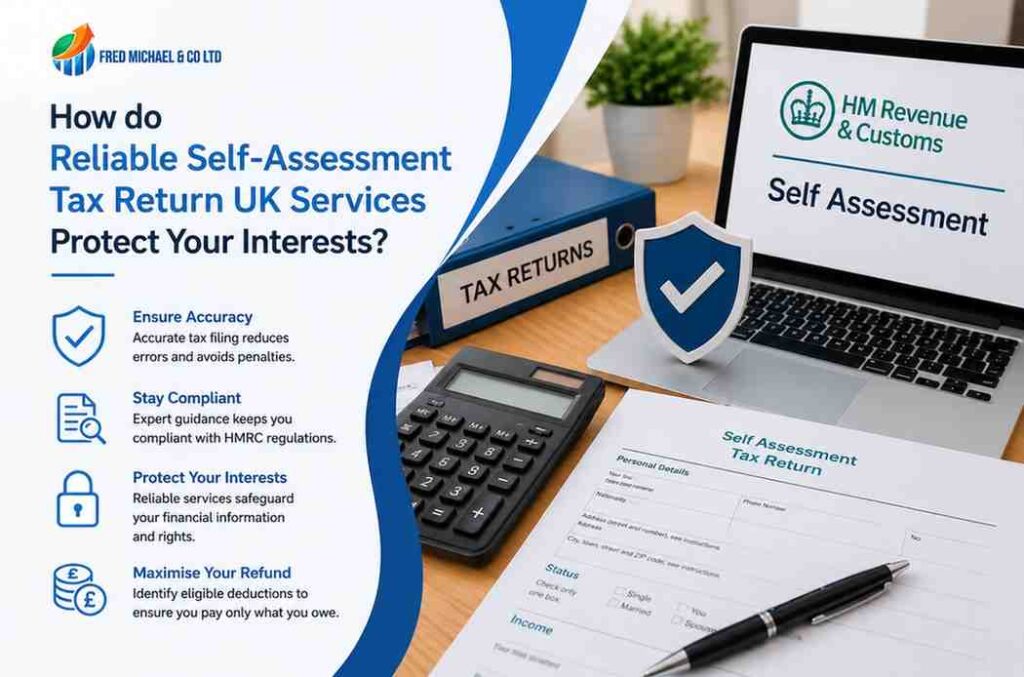
Professional tax advisors are trained to understand the full scope of HMRC requirements. They ensure that your personal tax return is completed accurately, with every figure double-checked and every eligible deduction properly claimed. This level of precision reduces your risk of penalties and keeps you fully compliant.
Maximum Tax Efficiency
A skilled tax professional does not just fill in forms, they actively look for ways to reduce your tax liability within the boundaries of the law. From pension contributions and gift aid relief to capital allowances and marriage allowance, there are often legitimate deductions that individuals miss when filing on their own.
Time Savings
Time is money, especially for business owners and self-employed professionals. Preparing a self-assessment tax return can take hours, sometimes days, if your finances are complex. Outsourcing this task to professionals frees you to focus on growing your business and generating income.
Peace of Mind
Knowing that a qualified expert has prepared and submitted your tax return gives you genuine peace of mind. You can rest assured that your return is compliant, accurate, and submitted on time, without the anxiety of wondering whether you have done everything correctly.
HMRC Investigation Support
If HMRC decides to investigate your tax affairs, having a professional tax advisor in your corner is invaluable. They can communicate with HMRC on your behalf, provide the required documentation, and protect your interests throughout the process.

Comprehensive Support for Growing Enterprises
As a business scales, tax responsibilities expand rapidly. Small business owners often find themselves stretched thin trying to balance customer acquisition with complex compliance. Securing dedicated self-assessment tax return support for small business ensures that your personal filings stay perfectly aligned with your corporate structures.
Furthermore, as your operations mature, a trusted accounting partner can seamlessly scale their support alongside your needs:
- Streamlined Team Management: Integrating outsourced payroll services ensures your staff are paid accurately and on time while flawlessly managing PAYE compliance, National Insurance, and workplace pensions.
- Strategic Growth Advisory: For businesses requiring high-level financial oversight without the executive price tag, fractional financial director services provide the cash-flow forecasting, risk management, and commercial strategy needed to scale safely.
Self-Assessment Tax Return Support for Small Business
Small businesses face unique challenges when it comes to tax compliance. Owners are often wearing multiple hats, managing operations, sales, customer service, and finances simultaneously. This is why self-assessment tax return support for small business is not just a convenience, it is a necessity.
Specific Ways Small Businesses Benefit
- Simplifying Complex Tax Situations: Small business owners often have multiple income streams, including trading income, investment income, and property income. A professional service simplifies this complexity and ensures everything is reported correctly.
- Identifying Allowable Business Expenses: Many small business owners miss out on legitimate expense claims simply because they are unaware of what qualifies. Professional advisors identify every allowable deduction, from home office costs and vehicle expenses to software subscriptions and professional development.
- Managing Payments on Account: HMRC requires self-employed individuals to make advance payments towards their next tax bill, known as payments on account. Understanding and managing these payments correctly is critical to avoiding cash flow problems, and professional advisors ensure you are never caught off guard.
- Planning for Growth: As a small business grows, its tax position becomes more complex. Professional self-assessment tax return support for small business includes forward planning to ensure that growth is managed in a tax-efficient way.
- Tax Return Outsourcing UK: Many small businesses are now embracing tax return outsourcing UK as a way to access expert knowledge without the cost of employing a full-time accountant. This model provides professional quality at an affordable price, making it ideal for startups and growing businesses.
Critical Deadlines to Protect Your Finances
To ensure your interests are fully protected, you must maintain a clear understanding of the strict annual timeline mandated by HMRC. Failing to meet these dates results in immediate, automatic financial penalties.
Milestone / Requirement | Critical UK Deadline |
Registration Deadline | October 5th following the end of the tax year |
Paper Tax Return Submission | Midnight on October 31st |
Online Tax Return Submission | Midnight on January 31st |
Final Tax Payment Due | Midnight on January 31st |
First Payment on Account | Midnight on January 31st |
Second Payment on Account | Midnight on July 31st |
Final Thoughts
Filing your Self-Assessment tax return doesn’t have to be a source of yearly stress. By setting up a clear operational workflow, organizing your records properly, and leveraging professional expertise, you can ensure your financial obligations are met flawlessly every single time. Taking control of your tax and payroll compliance today creates a professional, secure foundation that allows your business to scale smoothly.
At Fred Michael & Co Ltd, we handle the complexities of HMRC compliance, structural tax calculations, and back-office management so you can focus entirely on growth. Our tailored solutions eliminate administrative errors, protect you from costly penalties, and guarantee your financial interests are fully safeguarded all year round.
Ready to transform your financial operations and scale with absolute confidence? Contact Fred Michael & Co Ltd today to schedule your free consultation and discover the power of stress-free business management.